
TL;DR
Political polarization has two drivers that dwarf everything else: first-past-the-post elections and extreme gerrymandering. Every other cause, from social media algorithms to geographic self-sorting, operates on top of that foundation.
The only fix with large, enduring, scalable effects is changing the electoral system. Everything else nibbles on the edges.
If you want something you can do today: deep canvass your neighbors and tell them the other side does not hate them as much as they think. Know it will fade. Do it anyway.
I was invited to a dinner party among a small group of friends, and political polarization came up. I know. Exciting stuff. A person had read my post How to Actually Change Political Beliefs: Brain Shocks and Friend Swaps (The Science Says Nothing Else Works)
and was a little down. She is high on empathy, and in her heart she wants people to get along.
“So, you are saying the thing to do to mitigate political polarization is to change the political system, and have the people who benefit from it do the changing?”
Yes.
“Nothing else can be done?”
That is a different question.
Yes, other things can be done, but they are nibbling on the edges and unlikely to be long lasting. Let’s explore.
Review of Polarization’s Causes
First Past the Post and Winner Take All Elections
In my research and experience, The biggest single driver of political polarization today is first-past-the-post (FPTP) and winner-take-all elections.
Duverger’s law is a principle in political science stating that electoral systems using single-member districts and plurality voting (often called “first-past-the-post”) invariably tend to produce a two-party system.
In the US electoral system, you need 50% plus one vote and you win everything. The second-place finisher with 49% gets nothing.
In highly gerrymandered seats, you may only need 20 to 35% of the primary vote to win.
This system creates little to no incentive to build cross-party coalitions, and candidates maximize hostility toward the “others” to energize their base.
Extreme Gerrymandering
The second main driver is also structural: extreme gerrymandering.
Politicians now draw district lines using precise data and software to create safe seats rated D+20 or R+20.
In these safe districts, a primary challenge from your own party’s extreme flank is the real threat, not the general election. A representative never needs to appeal to the other side, often able to ignore it completely.
The result: compromising with the “enemy” signals weakness and creates political liability.
It is a vicious feedback loop.
These districts produce caucuses, and those caucuses have outputs and outcomes.
Together, FPTP/winner-take-all and extreme gerrymandering create the battlefield on which all other causes operate.
Political Elite Behavior
Leaders, would-be elected officials, and party operatives all operate within the system created by FPTP and gerrymandering.
The Shift to Negative (Affective) Partisanship
 Newt Gingrich changed the game in the 1980s. I personally think he gets too much credit, but he did recognize the changes in the system and was more than willing to pour gasoline on innate human nature.
The other party was no longer the “loyal opposition” but a dangerous enemy of a way of life.
Evil. You cannot compromise with Evil; you can only defeat it.
Running against the other Evil side boosted fundraising, media attention, and base mobilization.
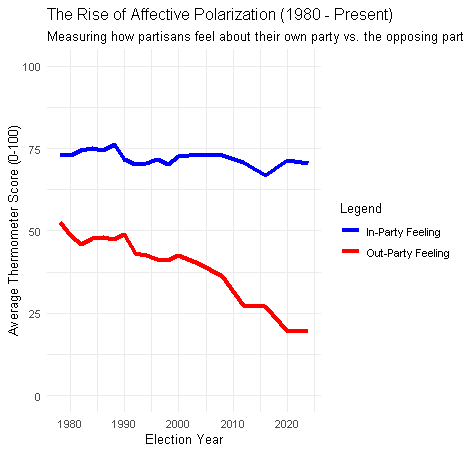
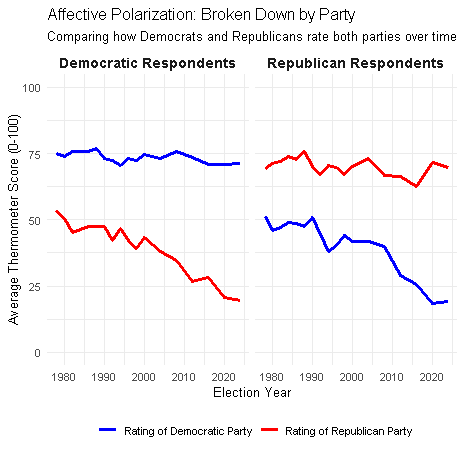
ANES data clearly shows ratings of one’s own party staying mostly stable, and ratings of the “Others” declining steadily.
There is little difference between the two parties on this. Both simply dislike the other.
Changing Media & Information Ecosystems
Extreme messaging from leaders lands on fertile ground because the media environment changed simultaneously.
Cable News & Talk Radio
Eliminating the Fairness Doctrine led to Fox News and MSNBC shifting from news to commentary. Add Rush Limbaugh, and 24/7 conflict-driven content became a permanent fixture.
Social Media & Algorithms
When platforms began tweaking algorithms to maximize “engagement,” they rewarded anger, contempt, and outrage.
All nuance disappeared. Extreme leaders and content got amplified.
These algorithms are parasitic on pre-existing human nature.
They manipulate the brain’s dopamine loops by aggressively amplifying outrage, fear, and tribalism to maximize user retention.
Did the social media companies set out to deliberately do this? Doubtful. They just wanted engagement at any cost to sell ads.
Now that they know they are causing harm, do they act? No. They do nothing for greed and fear of censorship charges and regulation.
Demographic & Geographic Self-Sorting
In the early 1970s, 25% of Americans lived in “Landslide Counties” where one party wins by 20 or more points. By 2020, over half of Americans did.
Now this pattern holds at the precinct level (our smallest unit of anlaysis).
Democrats live in urban areas, cities, and coasts. Republicans live in rural areas and exurbs.
You may not cross paths with someone who disagrees with you, let alone someone who looks or acts differently. If you do, they are the outlier to your reference group. Strange. Weird.
Party ID, the psychological attachment to a party identity, now predicts so many things: where you shop, what you drive, your favorite brands, and your views on culture, science, and morality.
Loss of Cross-Cutting Ties
We used to have shared identities that crossed politics. Big ones like “American.” We met in places like church groups and civic clubs, where people from different parties worked or played together.
We do not anymore. The slide was going on for years, the COVID plague smashed it.
It is now rare for a Democrat to marry a Republican, and vice versa. You never develop empathy for the other side because you rarely know them personally, and you start to think the other side dislikes you more than they really do.
How All These Causes Work Together (The Feedback Loop)
It is not one cause. It is a self-reinforcing cycle:
- FPTP + gerrymandering create safe seats and zero reward for cooperation.
- Political leaders adapt by using negative, outrage-driven campaigns.
- Media (especially social media) amplifies that outrage algorithmically.
- Americans self-sort geographically and socially into like-minded bubbles.
- Cross-cutting ties disappear — people lose direct, positive contact with the other side.
- Hostility feeds on itself: leaders respond to an angry base, media responds to outraged clicks, and voters demand even more extreme rhetoric.
What to do to reduce political polarization?
You could organize treatements by sector and brainstorm.
Strutural Changes
Some potential options here are:
- Adopt multi-member districts with proportional representation (breaks winner-take-all, forces cross-party cooperation)
- Independent redistricting commissions (reduces gerrymandering’s extreme effects)
- Ranked-choice voting (reduces negative campaigning and spoiler effects) I personally dislike this option, but we are brainstorming here.
- Mandate open primaries (reduces extreme candidate selection)
- Increase the size of the House of Representatives (makes districts smaller, more competitive, and less gerrymanderable)
Media & Information Changes
Some potential options here are:
- Hold platforms accountable for the content they host, you know the lies, the misinformatin, the utter bullshit.
- Algorithm-neutrality regulation (require social media platforms to reduce outrage-amplifying algorithms)
- Cross-cutting exposure nudges (platforms show users content from the other side periodically)
- Slow-down prompts (require a 10-second delay before sharing emotionally charged political content)
- Fact-checking labels with empathy framing (not just “false” but “this claim is misleading; here is why someone might believe it”)
- Replacement of the cable news conflict format (regulatory or market-based; both are highly unlikely)
Individual-Level Psychological Interventions
Some potential options here are:
- Perspective-getting (structured, deep listening to a real person from the other side, not just imagining their views)
- Induced shared identity (priming “American,” “parent,” or “veteran” before political discussion)
- Empathy exercises (reading narratives about suffering on the other side)
- Meta-polarization correction (teaching people that they overestimate how much the other side hates them; this alone reduces hostility)
- Contact theory interventions (sustained, equal-status, cooperative contact across party lines)
- Common threat or superordinate goal (climate change, pandemic, alien invasion; any shared problem)
All of these feel manipulative regardless of their effects, and individual treatments by definition do not scale.
There has been interesting research on the effectiveness of deep canvassing. It just does not scale. It requires extreme effort and time.
Social / Community-Level Interventions
Some potential options here are:
- Rebuilding cross-cutting civic institutions (PTAs, bowling leagues, community service projects that mix parties)
- Cross-partisan service requirements (a national service year that deliberately mixes political groups)
- Partisan desegregation of neighborhoods (housing vouchers or incentives to reduce geographic sorting; good luck)
All of these feel out of reach in a culture that celebrates individual freedom. Bussing people to schools caused a rift, let alone government relocating people into neighborhoods, will be deeply controversial. And I frankly do not know how you systematically build a cross-cutting bowling league.
Elite and Elecotial Facing Changes
Some potential options here are:
- Make primaries less powerful
- Campaign finance reform (subsidize positive ads; charge a premium rate for negative ads)
- Campaign finance reform focused on transparency around dark money
- Require cross-party qualification requirements: candidates must gather a percentage of qualifying petitions from the other side
Single Best Intervention to Reduce Political Polarization
If we locked the world’s best political scientists, psychologists, and human behavior researchers in a room with agreed-upon criteria and did not let them out until they reached consensus, the answer would look something like this.
The Criteria:
- Does the treatment produce a large effect?
- Does the effect endure?
- Is it scalable to a population the size of the United States?
- Does it require changing human nature? If so, drop it.
- What is the political difficulty?
Scalability and enduring effect rule out every individual-level treatment.
The winner:
Change the electoral system. Move away from FPTP and winner-take-all toward some form of proportional representation.
Yes, it is politically extremely difficult. It is also where the biggest, enduring gains are.
Everything else nibbles on the edges.
If you insist on something actionable that just takes time and effort but is not scalable, combine deep canvassing techniques with meta-polarization correction. Tell people: “The other side does not hate you as much as you think, and here is the proof.”
These effects fade within weeks unless repeated.
So:
What is the most effective long-term solution? Change the system.
What can I do in my community? Deep canvassing and meta-polarization correction.
None of these are easy.
Conclusion
I am not optimistic. The structural fixes require the beneficiaries of the current system to dismantle it. That is a bad bet.
The alternative is to do nothing, and doing nothing is a choice with its own consequences.
My friend at that dinner table wanted something she could actually do. She wanted agency.
So here it is:
Deep canvass. Correct the record on how much the other side actually hates you. Fight for electoral reform even when it feels pointless.
Someone has to make the donuts.
History does not reward the people who waited for a better moment.