Electoral Politics and Representation
My interest here is not in helping the Democratic Party rebuild itself in Florida, but to have a difficult conversation.
My first paid campaign experience was in 1992. I took a summer off school and worked as a finance director for a congressional campaign in a newly drawn minority access seat.
I worked for a liberal lion. She had been re-elected to state legislature multiple times, in a district with a significant African American population, broadly popular, and there is simply no way to question her liberal cred.
But, she made an error. She believed supporters of hers for years would support her again as she attempted to make the jump to Congress.
In several meetings with long time supporters, I heard some version of “We love you, but you aren’t Black.”
The opponent, a black man, a man the US House had impeached 413 to 3 and the Senate had removed from the federal bench three years earlier on bribery charges. Every voter in that district knew it. It did not matter.
(Side-note: The man they chose over her went on to generate the largest sexual harassment settlement in congressional history, $220,000 paid by taxpayers. But that came later.)
The Black press vilified a woman they had lauded for years, calling her a carpetbagger and worse.
The desire to have representation mattered and that was a line in the sand.
I learned so many lessons on that early campaign, and I have thought about that campaign for thirty years. I never forgot that identity matters.
Representative Debbie Wasserman Schultz
This week, Representative Debbie Wasserman Schultz announced she will seek reelection in Florida’s newly drawn 20th Congressional District, a majority-minority seat where roughly 42 percent of the voting-age population is Black and more than 23 percent is Hispanic.
She moved there because Florida Republicans’ mid-decade redistricting eliminated her previous seat. Black Democrats responded immediately.

The Florida Legislative Black Caucus said she had ignored requests from the Black community to run elsewhere.
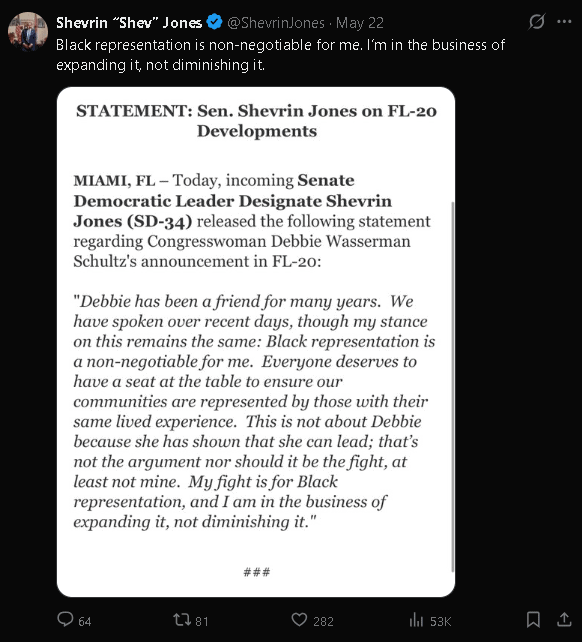
State Senator Shevron Jones, himself considering a run for Congress, said “Debbie has been a friend for years……My fight is for Black representation.”
And then this:
“This is not the moment for forum shopping,” said outgoing member Sheila Cherfilus-McCormick. “What matters is to make sure Black representation is actually present.” You know Former Rep Cherfilus-McCormick, the Representative who resigned last month following congressional ethics and legal deliberations over allegations she allegedly stole federal emergency funds and routed them to her congressional campaign?
So, I am having flashbacks. An established white liberal, running in a minority access seat against a ethically flawed candidate.
“Sorry, we love you, but you aren’t black.”
Thirty plus years separate those two moments. The argument is identical.
“We love you, but you aren’t Black.”
What the Map Shows
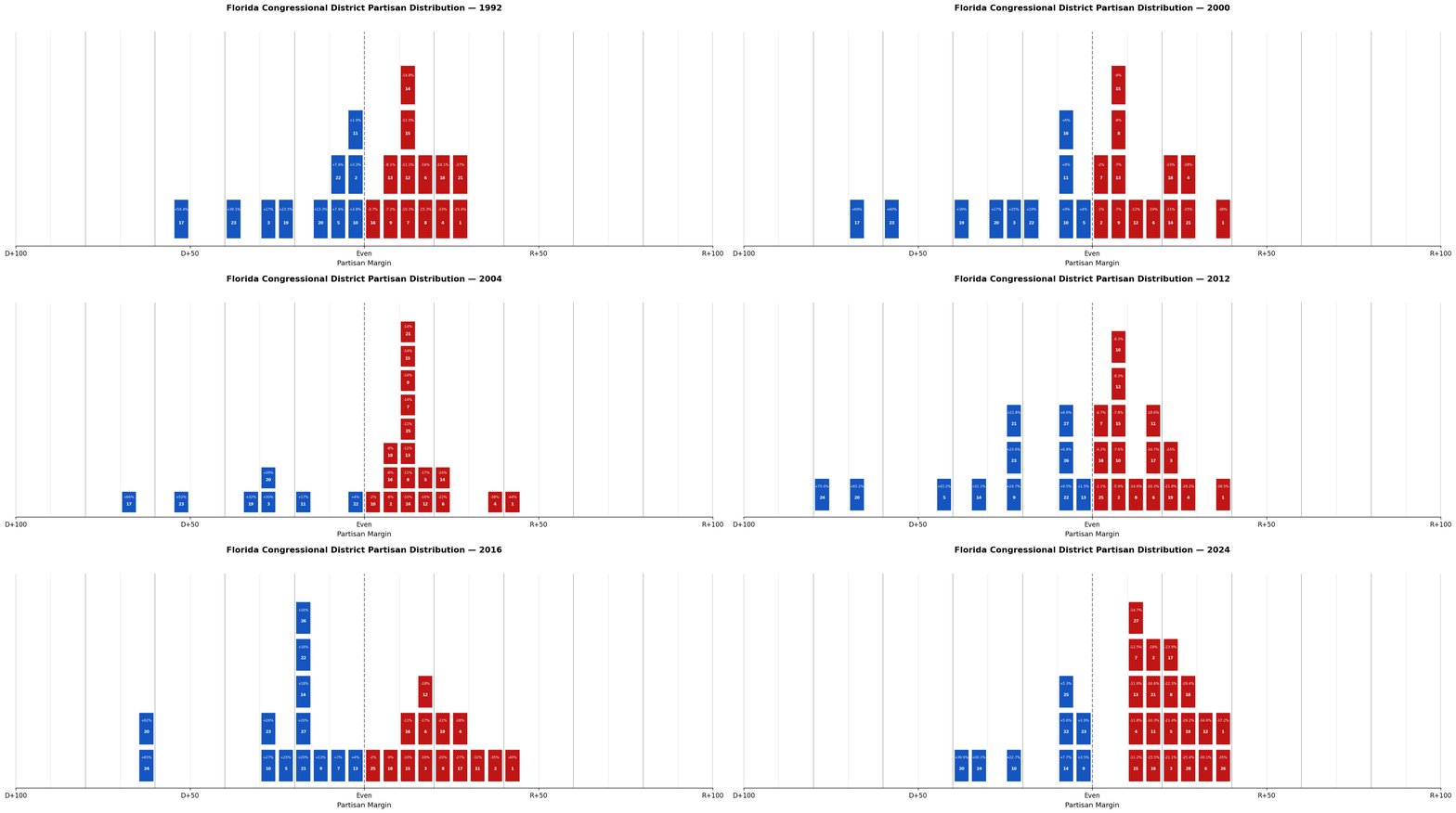
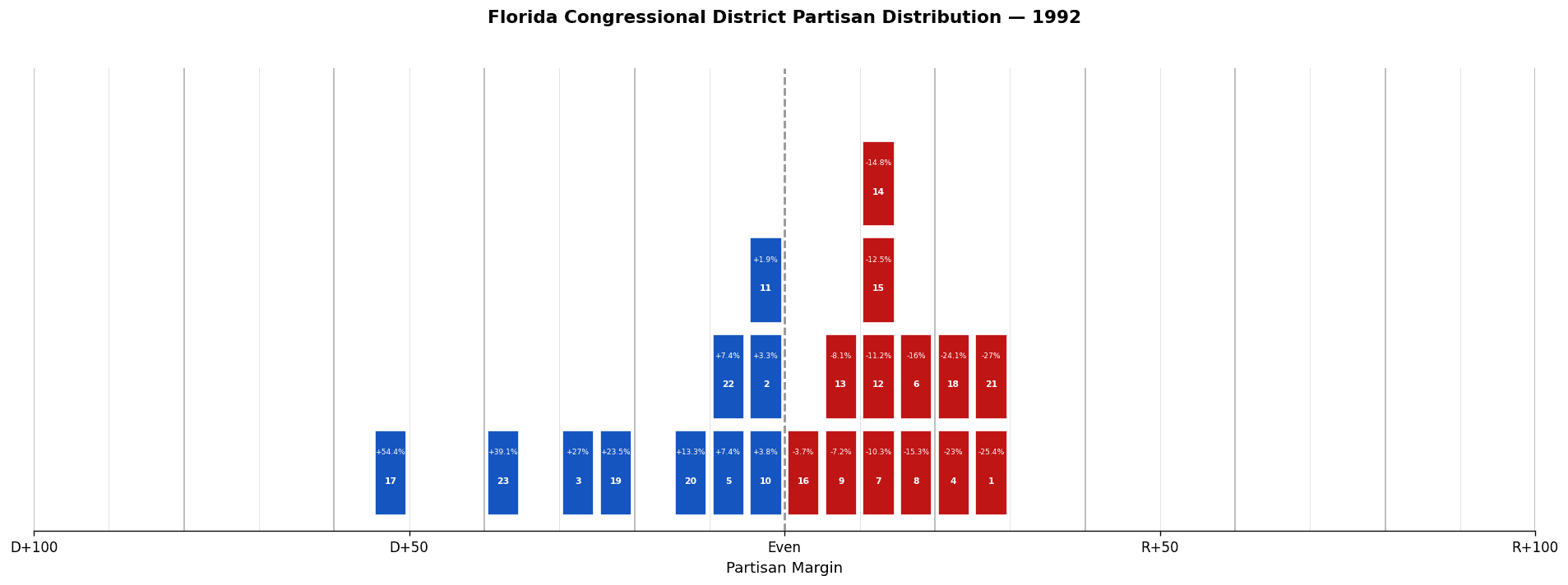
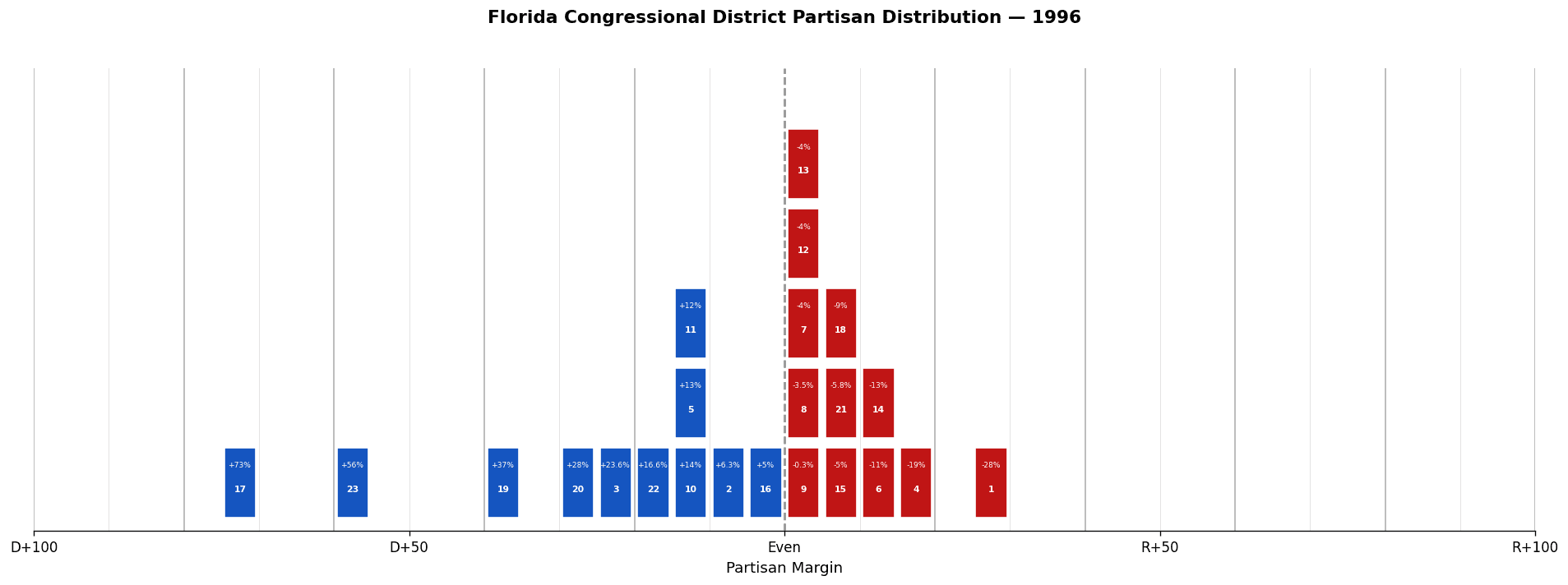
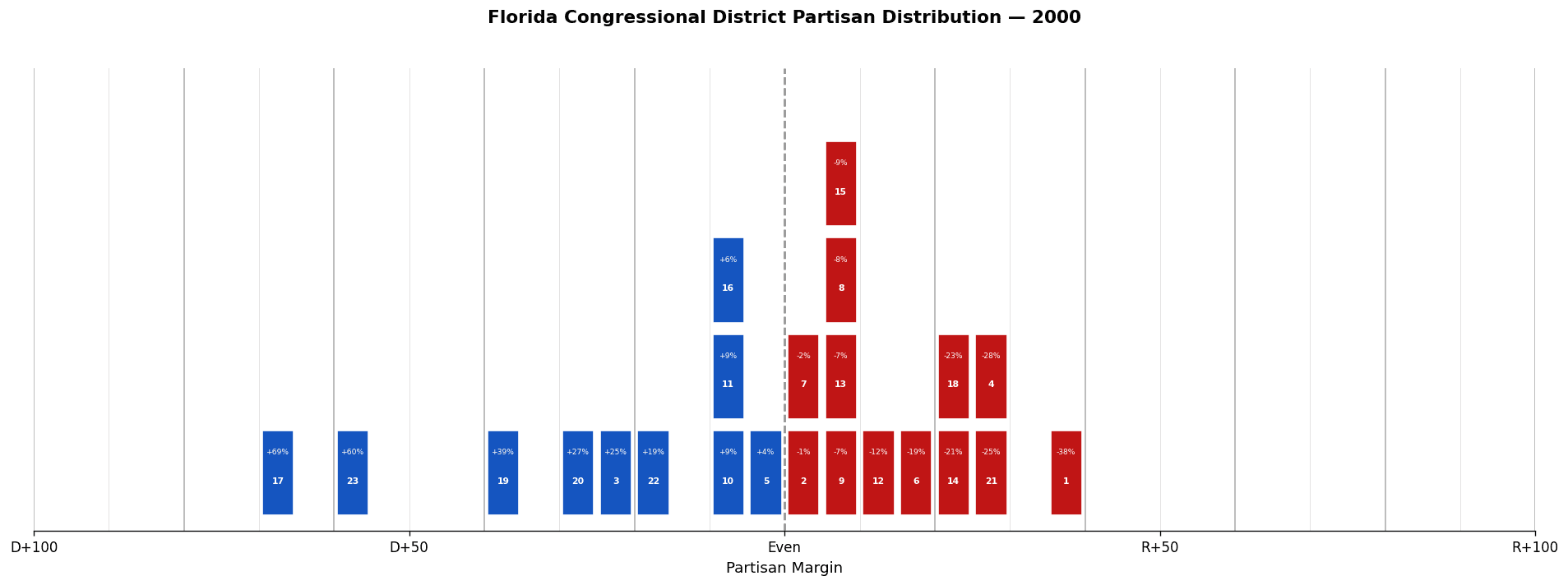
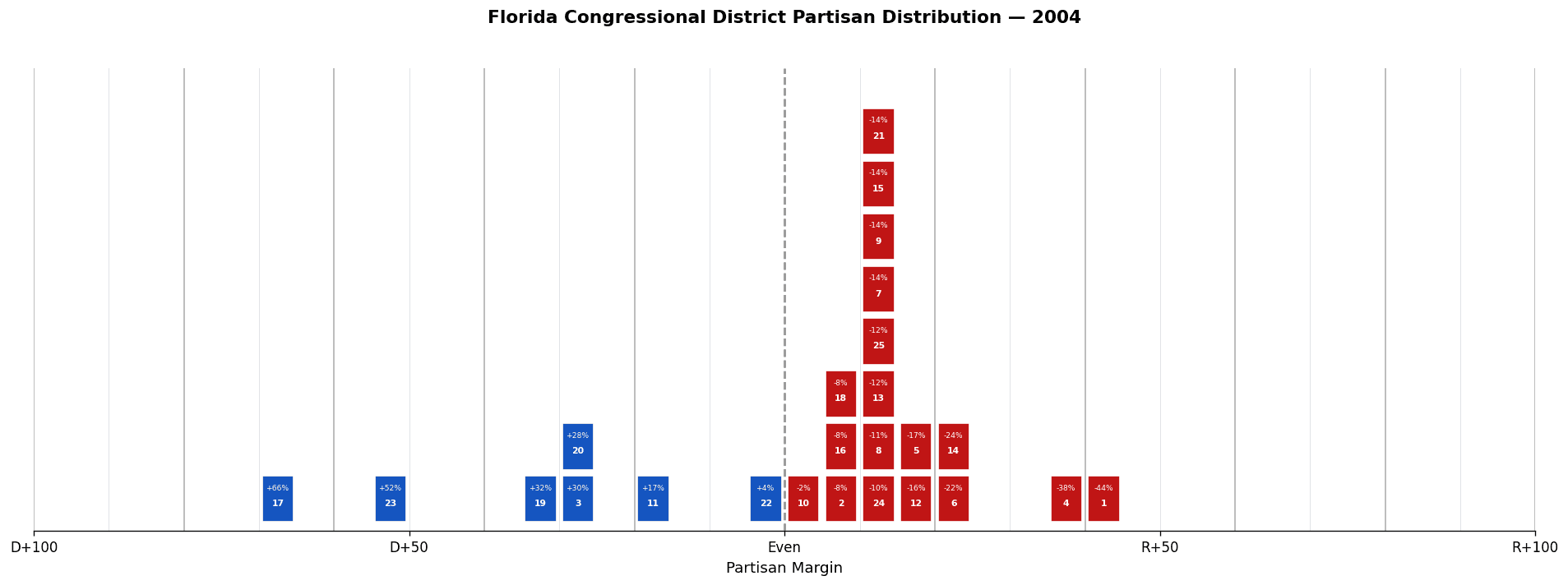
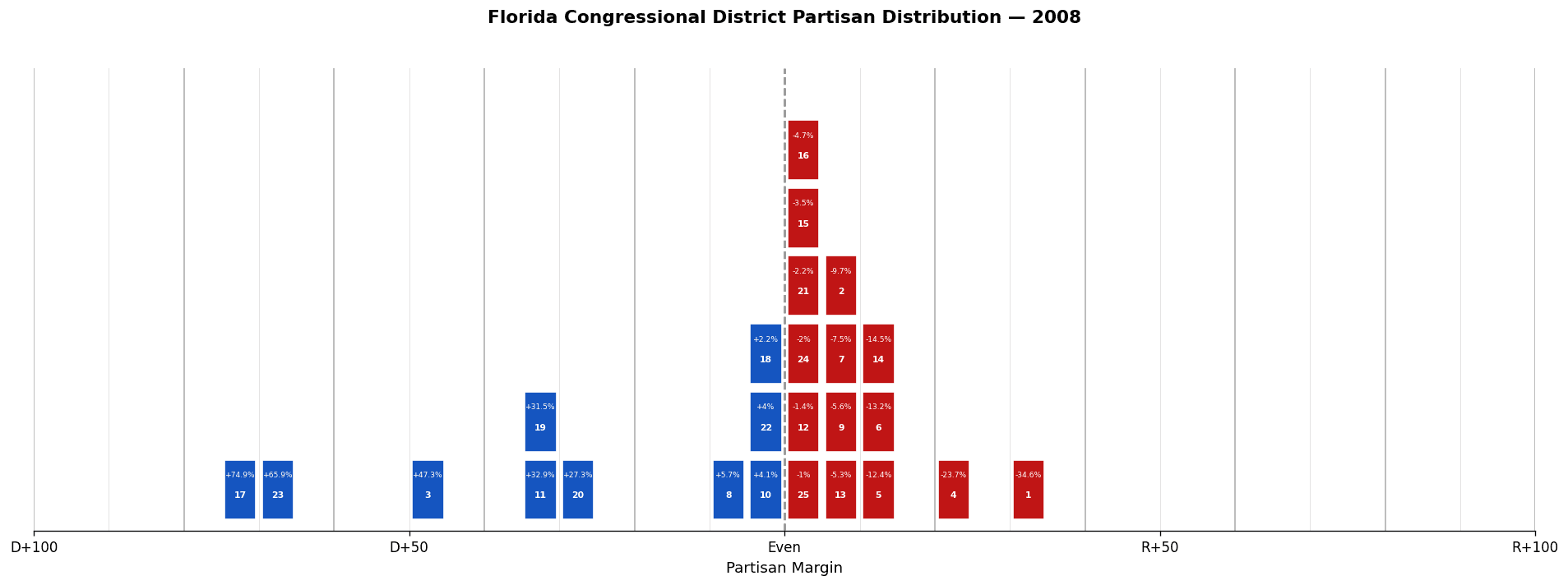
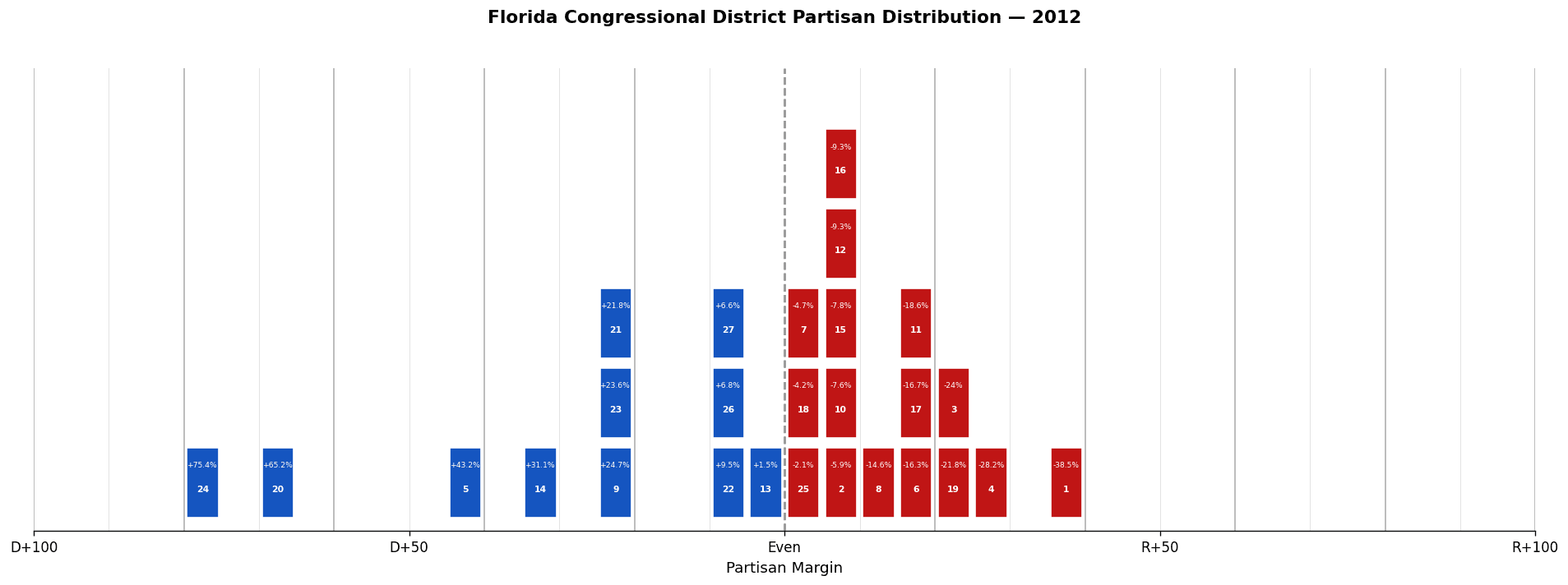
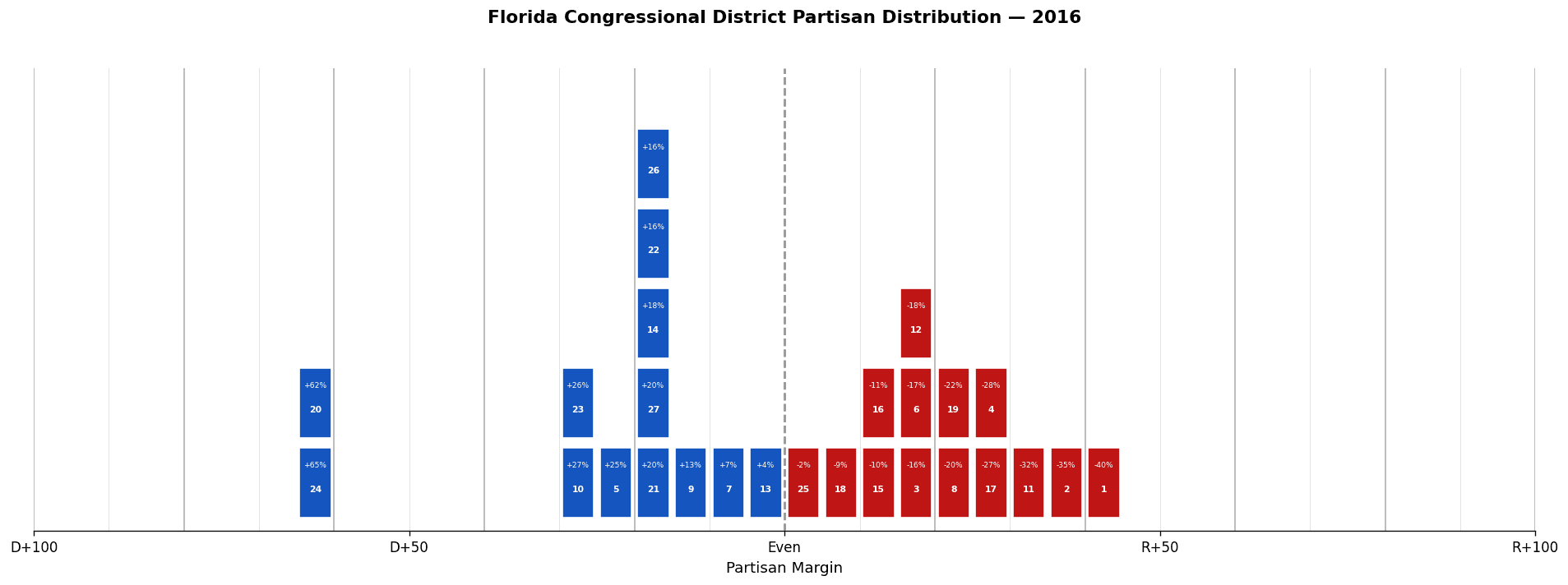
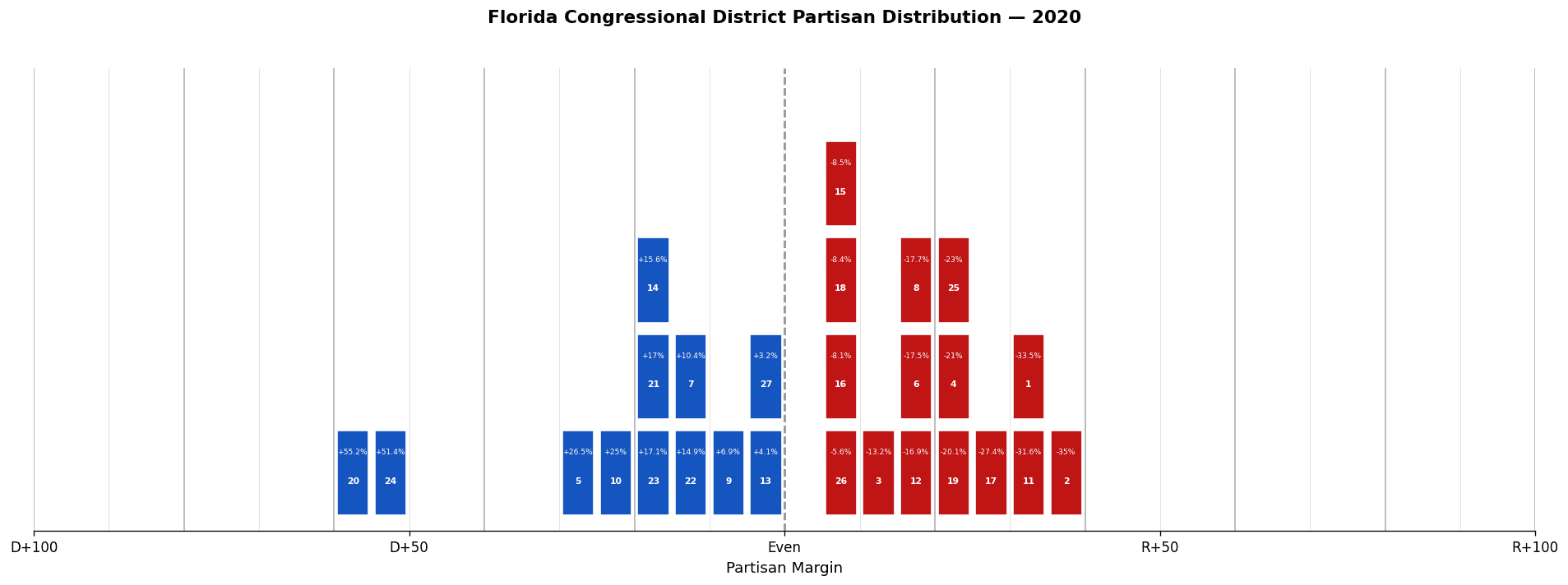
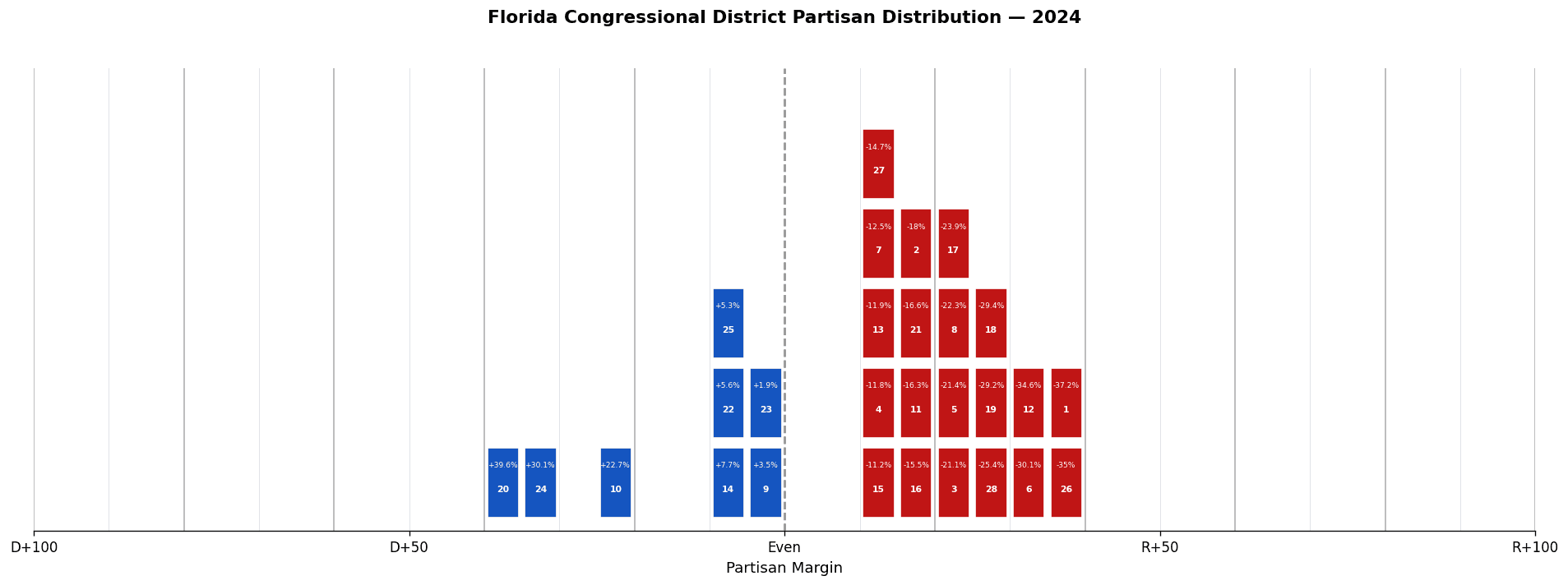
The GIF above and frames below displays Florida’s congressional districts from 1992 – 2026, plotted by partisan margin from the 50 percent threshold. (Thanks to Patrick Ruffini for the data viz idea)
The pattern is stark. Several Democratic districts cluster far left of center, carrying margins between D+20 and D+54. District 17 sits at +54.4 points. The majority-minority seats drawn under the Voting Rights Act hold Democratic voters so densely that their margins approach a theoretical ceiling. The Republican seats, by comparison, cluster in the R+8 to R+25 range, far less extreme (except the panhandle.)
This is the geometric logic of packing. Drawing a majority-minority seat requires concentrating minority voters above a threshold, typically 55 percent or more of the voting-age population, to overcome racially polarized voting patterns that minority candidates would otherwise face. The mechanism that protects the seat also empties surrounding districts of their Democratic base. Every liberal voter drawn into a minority access seat is a Democratic vote removed from a neighboring district that might otherwise be competitive.
In Florida, where statewide margins have historically been razor-thin, the arithmetic of packing carries real electoral weight. You can look at the gif as it progresses. The marginal +R districts held even during the Obama wave. The surrounding districts that might otherwise lean Democratic became / remained Republican. SUPER-safe Democratic seats do not add to a majority; they simply hold territory already held.
What Research Says About Representation After Election
The effects do not stop at the district line. Canon (1999) and Tate (2003) find that representatives from majority-minority districts consistently prioritize issues of specific concern to Black constituents, including civil rights enforcement, anti-poverty policy, and criminal justice reform, relative to members from more racially mixed districts. This is responsive representation. It is also, by construction, narrower in scope.
The incentive is straightforward. If elected officials are “single-minded seekers of re-election, they will stay close to the voters that got them there.
Swain (1993) raises the sharper version of the argument: electing Black representatives from safe majority-minority seats may actually reduce substantive policy responsiveness for Black Americans across Congress as a whole, by concentrating Black influence in a handful of safe seats rather than distributing it across a larger number of marginal ones. Lublin (1997) pushes back on that claim, but the underlying tension is real. A member elected by a D+50 constituency answers to a different coalition than one elected by a D+8 constituency.
The incentive structure compounds over time. Members from safe minority-access seats face little general-election pressure and strong primary pressure from within their concentrated constituencies. Their policy positions and messaging adapt accordingly. This is rational behavior. Viewed from the perspective of a party trying to win statewide or build legislative majorities, it can become a liability. The member becomes associated with a specific, concentrated constituency rather than a broader coalition, and in a media environment that amplifies conflict, that association hardens.
1992
1996
2000
2004
2008
2012
2016
2020
2024
Florida’s Three-Decade Trajectory
Florida has sent African-American members to Congress consistently since 1992 from safe majority-minority seats. Their longevity reflects the electoral security packing provides. Their committee assignments, floor priorities, and public profiles have tracked closely with the core concerns of their concentrated constituencies, which is exactly what those constituencies elected them to do.
The non-majority-minority Democratic seats have become less competitive over successive redistricting cycles. Florida trended Republican in statewide elections through the 2000s and 2010s. Whether packing caused that decline or failed to prevent it is a genuine empirical question. The correlation between concentrated minority seats and eroding Democratic margins in surrounding districts is visible in the data across election cycles.
The current redistricting fight makes the dynamic explicit. Florida Republicans drew a map that eliminated a white Democrat’s seat and preserved the majority-minority districts, because preserving those districts under current Voting Rights Act jurisprudence also locks surrounding geography into Republican-favorable configurations. The map serves two goals at once: it complies with minority representation requirements, and it maximizes Republican seats. Those goals do not conflict. They are the same goal.
Tom Slade would be so proud.
The Coalition the Map Built, and the Voters Who Don’t See Themselves in It
When a party can only win the seats its map allows it to win, the caucus that emerges reflects those seats. Florida’s Democratic legislative caucus, in Tallahassee and in Washington, is now composed almost entirely of members representing majority-minority or dense urban districts. That is not a failure of recruitment. It is the direct output of three decades of packing.
This geographic and demographic isolation drives the balkanization of the party or the splintering a once-broad, statewide coalition into hyper-concentrated factions that only need to speak to their immediate base.
The caucus that results from those districts sends a signal, intended or not.
Voters who find no one like themselves within it reach a straightforward conclusion: this party is not for people like me.
That perception is not driven by hostility from any individual member. It is a structural output, the predictable result of a coalition shaped almost entirely by the constituencies packing produces.
The 2024 election data quantifies exactly how many voters reached that conclusion. White men without a college degree voted for Donald Trump by a 40-point margin, 69 percent to 29 percent, according to NBC News exit polls. Men under 50 swung toward Trump between 2020 and 2024; Biden had won that group by 10 points four years earlier. Pew Research found roughly 8 in 10 Trump voters identified as Christian, compared to roughly half of Harris voters. The religious and educational profile of the party’s defectors maps closely onto the demographic profile almost entirely absent from the party’s elected leadership in states like Florida.
The political elite cues matter. Voters take cues from who the party elevates, not just what the party says.
If Representation Matters, It Matters for Everyone
Look at the Florida Democratic roster. The House Democratic Minority Leader is a Black woman. Her leadership team includes a Black woman whip, a Jewish male floor leader, and two white women in the top succession spots. The Senate Democratic leader is a Jewish woman. The congressional delegation’s white members are a gay woman and a Jewish woman. Across the state House, the state Senate, and the congressional seats Florida Democrats currently hold, there is not a single white, straight, Christian man in a prominent elected or leadership position.
That observation carries no judgment about any of those individuals. They are qualified, elected, and serving their constituents. The point is different: the Democratic Party spent thirty years building “representation matters” into its core governing philosophy.
It pressed that argument in courts, in redistricting fights, in candidate recruitment, and in messaging to voters. The argument holds that people need to see someone like themselves in elected office to believe government works for them.
Ironically, they seem to have forgotten the single largest demographic bloc in the Florida electorate and in the American electorate broadly.
The result is not that the party became hostile to those men (however there is data to support the perception they are perceived to be hostile). The result is that it became invisible to them. A 62-year-old white man in rural Florida, sees no one who shares his background, his faith, or his experience of the world. He does not conclude the party hates him (maybe some do). He concludes the party is not for him, and he votes accordingly.
The 2024 exit polls answer through revealed behavior. White non-college men voted for Trump 69 to 29. Men under 50 swung 20 points toward Trump compared to 2020. Roughly 8 in 10 Trump voters identified as Christian; roughly half of Harris voters did. These are not small movements at the margins. They are a coalition in collapse among voters the party once held and no longer contests.
Here is the Catch
The mechanism that produced this outcome runs directly through the redistricting logic this piece describes.
Packing created safe seats —> Safe seats produced a caucus —> The caucus reflects primarily the constituencies that packing preserved —> Those constituencies do not include the white, working-class, Christian communities that once split their tickets or leaned weakly Democratic —> So those communities produced no Democratic elected officials —> So those voters have no one in the party coalition who looks like them —> So they left.
The party can argue that its policies serve those voters regardless of who delivers them. That argument has not worked. Voters do not experience policy in the abstract. Said another way, policy and 10 point plans matter little in voting behavior.
Voters experience it through the people asking for their trust. When none of those people share their background, the ask lands differently.
Representation matters. The party has insisted on that for thirty plus years.
Ok, the standard applies to everyone.
A Genuinely Difficult Tradeoff
This analysis does not argue against majority-minority districts. The descriptive representation gains are real. Before 1992, Florida had sent no Black members to Congress in the twentieth century. Descriptive representation affects not just who holds seats but who runs for office, who participates in the political process, and what gets taken seriously in legislative debate.
I am genuinely mixed on this, and I say that as someone who watched it play out from inside a campaign in the year it started.
The voters in that 1992 district were right to want a representative who looked like them and had lived what they lived.
Political scientists were also right to worry that the resulting maps would cost Democrats seats for decades.
Both things were true then. Both things are still true now.
What the Wasserman Schultz controversy illustrates is that the Democratic Party has never developed a coherent answer to the structural tradeoff baked into the 1992 redistricting cycle. It celebrated the representational gains. Thirty-four years later, a white Democrat in a gerrymandered state is standing in front of an Obama poster trying to win a majority-Black seat, and the argument playing out on social media is the exact same argument I watched play out in a South Florida runoff in 1992.
Recognizing both outcomes is not the same as resolving the tension between them. It is, at minimum, a precondition for having an honest conversation about what redistricting does, who it serves, and what the Democratic Party actually wants its map to accomplish.
If race and representation matter, then they matter for everyone. The Democrats may need fewer safe seats and more competitive ones. Each time they have tried that, their own lawmakers sue. And to compete in marginal seats, they may have to, gasp, find a candidate who actually looks like a district.
References
Academic Sources
Canon, D. T. (1999). Race, Redistricting, and Representation: The Unintended Consequences of Black Majority Districts. University of Chicago Press. ISBN: 978-0-226-09271-3
Lublin, D. (1997). The Paradox of Representation: Racial Gerrymandering and Minority Interests in Congress. Princeton University Press. https://doi.org/10.1515/9780691221397
Swain, C. M. (1993). Black Faces, Black Interests: The Representation of African Americans in Congress. Harvard University Press. ISBN: 978-0-674-07615-0
Tate, K. (2003). Black Faces in the Mirror: African Americans and Their Representatives in the U.S. Congress. Princeton University Press. ISBN: 978-0-691-11786-7
Legislation
Voting Rights Act of 1965, 52 U.S.C. § 10301 et seq.
News and Polling Sources
NBC News. (2024, November 5). 2024 National Exit Polls.
https://www.nbcnews.com/politics/2024-elections/exit-polls
Cherfilus-McCormick and DWS, redistricting and Black caucus response:
https://www.nbcmiami.com/news/local/cherfilus-mccormick-intends-to-run-for-reelection-as-dems-challenge-new-redistricting-maps/3807873/
Shevrin Jones quote and district demographics:
https://www.miramarflnews.com/news/government/article315858747.html
The Hill, Trump and Gen Z, white male voter trends:
https://thehill.com/opinion/5465767-trump-gop-dominating-with-gen-z-white-zoomers-hate-dems/
Politico, Democratic Party and masculinity:
https://www.politico.com/news/magazine/2023/07/16/democrats-masculinity-roundtable-00106105