
Welcome to our deep dive into Florida’s registered electorate. If you want to understand the political currents of the Sunshine State, you have to look under the hood at who is actually registered to vote.
In this report, we break down exactly what the Florida electorate looks like today in 2026, followed by a high-level look at the massive demographic and political shifts that have transformed the state since 2018. In additional installments, we will drill down even further.
You can find a list of the questions here:
TL,DR;
- The 2026 Baseline: Florida currently has 16,136,315 registered voters, with the vast majority (82.9%) classified as active.
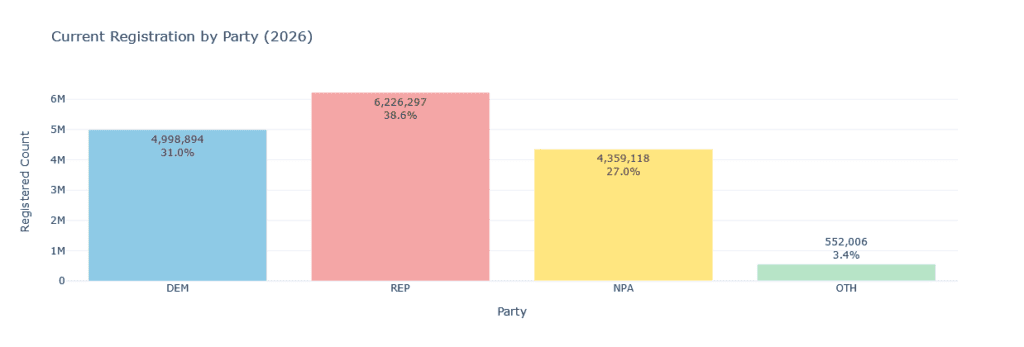
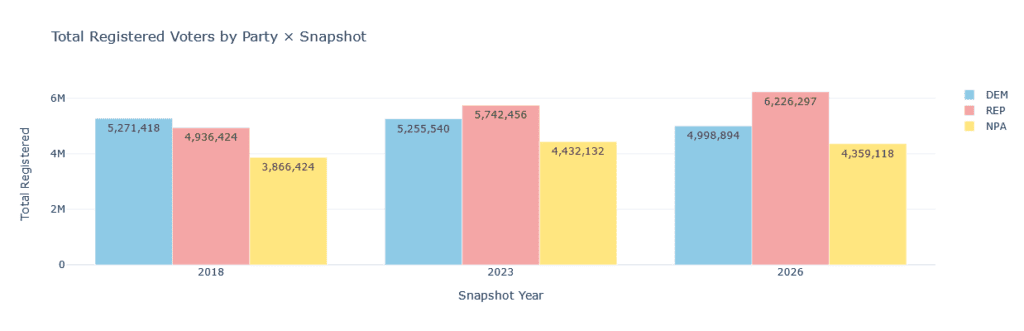
- The Massive Red Advantage: Republicans currently hold a commanding lead, making up 38.6% of the electorate (6.22 million voters) compared to Democrats at 31.0% (4.99 million). Non-Party Affiliates (NPAs) sit at 27.0% (4.35 million).
- A Tale of Two Trajectories: Since 2018, Florida has added nearly 2 million voters (+13.7%). However, while the GOP gained over 1.28 million voters and NPAs grew by nearly half a million, Democrats actually lost roughly 272,000 registered voters.
- An Aging Blue Base: The electorate as a whole is getting older, but the Democratic Party is graying the fastest. Voters aged 65+ grew by nearly 5 percentage points as a share of all registered Democrats since 2018.
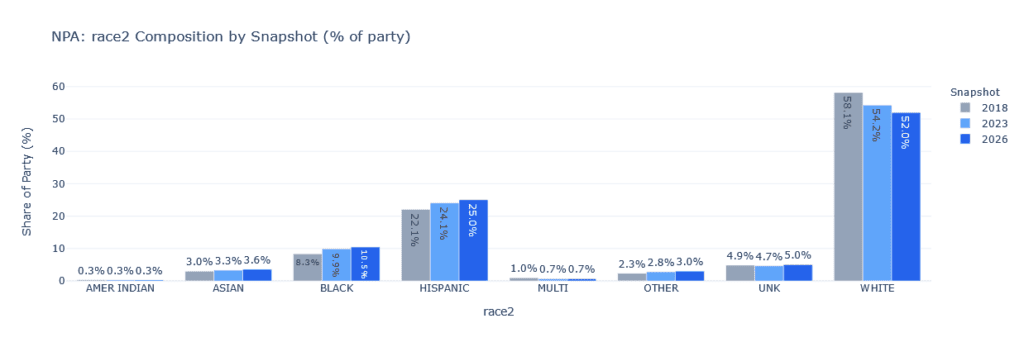
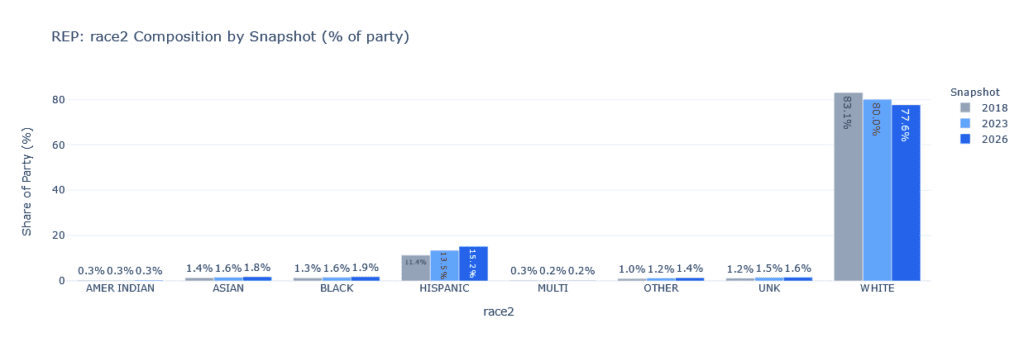
- A Diversifying GOP and NPA: White voters are shrinking as a share of all party coalitions. The Republican Party has seen a significant influx of Hispanic voters, while Independent (NPA) growth is increasingly driven by Black and Hispanic voters.
- Independents Flipped to Female: In a surprising demographic shift, Non-Party Affiliates went from heavily male-dominated in 2018 to female-dominated by 2026.
Part 1: The Current State of Play (2026)
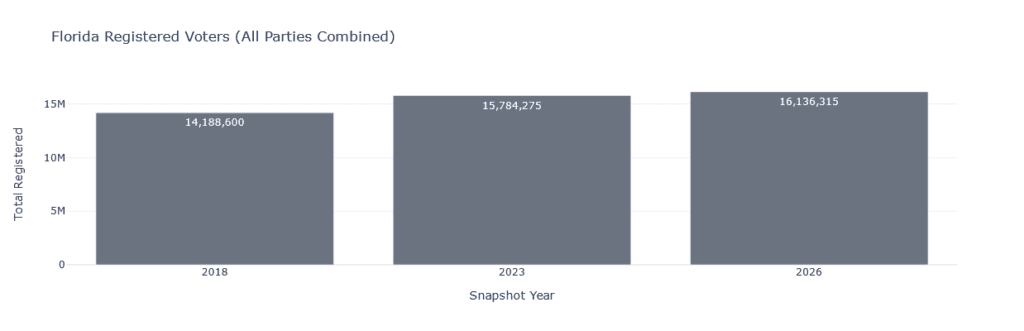
Florida’s voter file is massive, diverse, and distinctly red-leaning at the top level. Here is exactly who makes up the state’s 16.1 million registered voters today:
The Party Split
Republicans have built a formidable firewall. There are currently 1.22 million more registered Republicans than Democrats in Florida. The GOP boasts 6.22 million voters to the Democrats’ 4.99 million. Meanwhile, 4.35 million voters have chosen to register as Non-Party Affiliates (NPAs), making them the crucial swing bloc in statewide races.
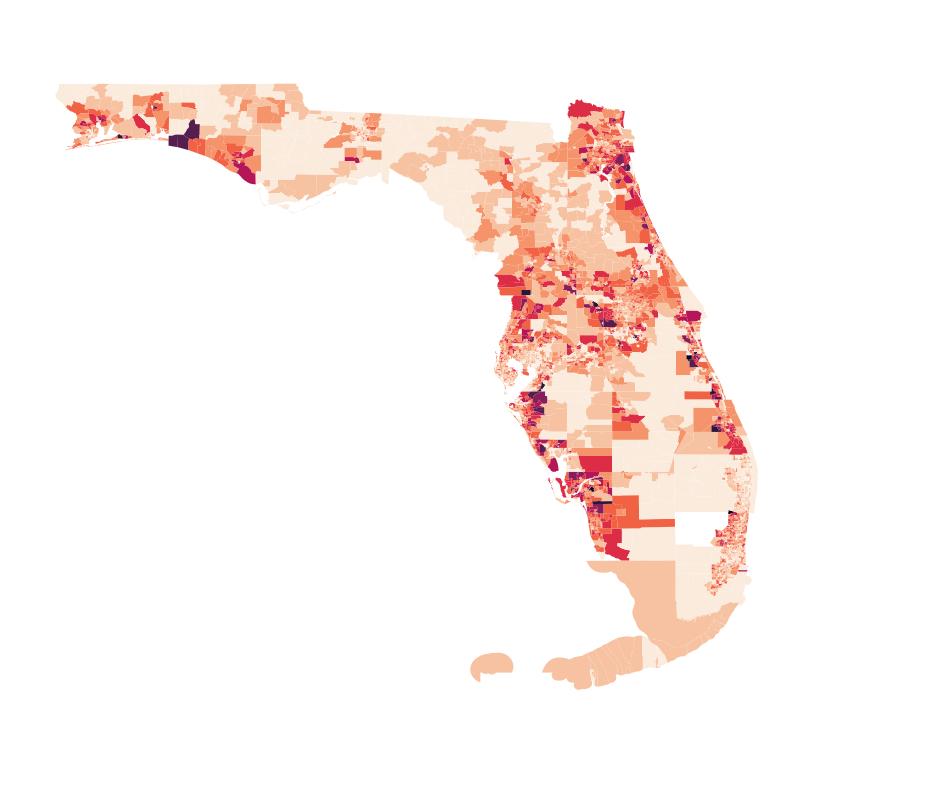
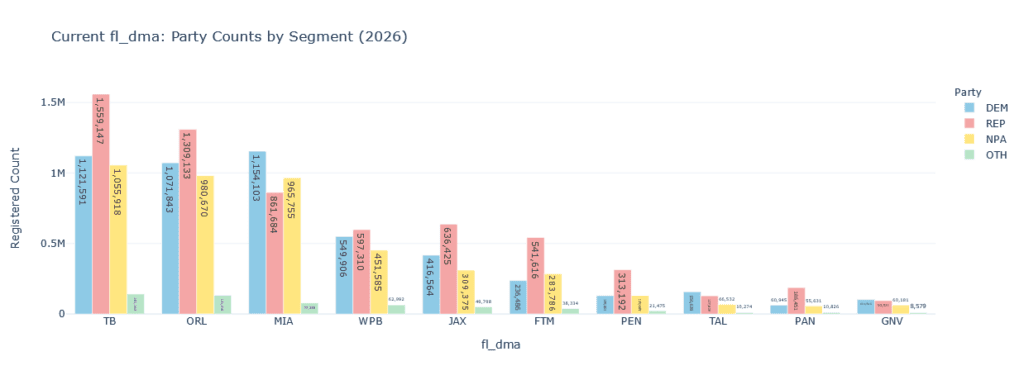
Geography: The Big Three Markets
Political power in Florida is highly concentrated in its major media markets.
- Tampa Bay (TB) is the largest battleground, home to 3.87 million voters. It leans slightly red, anchored by 1.55 million Republicans and 1.12 million Democrats.
- Orlando (ORL) follows closely with 3.49 million voters. It is highly competitive but leans red (1.30 million Republicans vs. 1.07 million Democrats).
- Miami (MIA) remains the state’s third-largest market with 3.05 million voters. It is the only top-three market where Democrats hold a registration advantage (1.15 million Democrats to 861k Republicans)
Demographics at a Glance
- Gender: Florida’s electorate leans heavily female. There are over a million more registered women (8.42 million) than men (7.32 million). Interestingly, the Democratic party skews heavily female, while the GOP is split almost exactly 50/50.
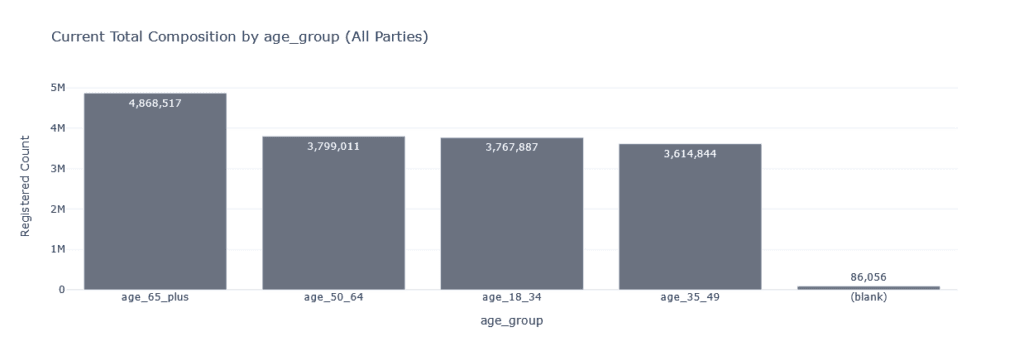
- Age: Florida lives up to its reputation. The 65+ demographic is the single largest voting bloc in the state (4.86 million voters), outpacing every other age group by over a million registrations.
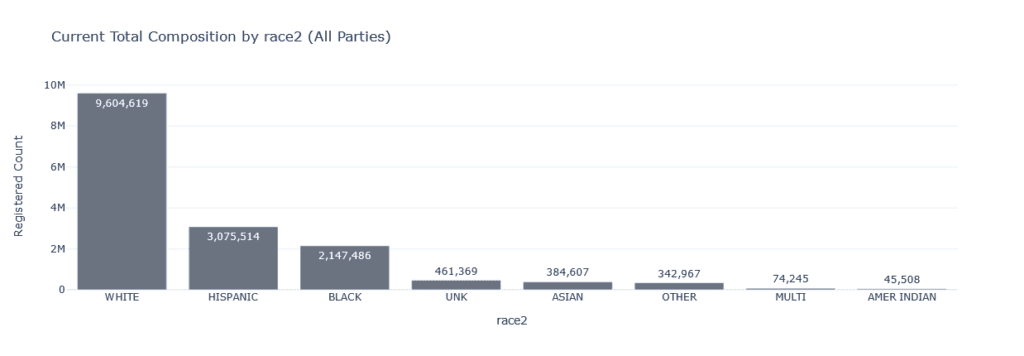
- Race: White voters make up the majority of the state (9.60 million), followed by Hispanic voters (3.07 million) and Black voters (2.14 million). Republicans absolutely dominate the White vote, Democrats easily win the Black vote, and Hispanic voters are highly fragmented, making up 25% of the NPA coalition. Republicans have a diversity issue, Democrats have a white issue.
Part 2: How We Got Here (Changes from 2018 to 2026)
Florida’s current red hue wasn’t always this stark. In 2018, Democrats actually held a 2.4-point registration advantage. Today, Republicans boast a 7.6-point advantage. Here is how the demographic ground shifted beneath our feet over the last eight years:
The Incredible Shrinking Democratic Edge
While the state’s population boomed (adding nearly 2 million voters), Democratic registration went backward. The GOP captured the lion’s share of the state’s new growth, adding roughly 1.29 million voters. NPAs grew as well. The net loss of 272,000 Democrats over an eight-year period points to both a lack of new Democratic registrants and party-switching among existing voters.
The Aging Democratic Coalition
Florida’s population is aging, but it is hitting the Democratic party the hardest. In 2018, the 65+ crowd made up 27.8% of the Democratic base. Today, they make up 32.5%—a massive 4.67 point jump. Conversely, NPAs are losing their youth edge: 18-to-34-year-olds dropped from 33.4% of the independent pool down to 29.1%.
A Diversifying Electorate
The state is becoming less uniformly White, and you can see it clearly in the changing faces of the GOP and Independent coalitions.
- The Hispanic GOP Surge: The Republican party has made undeniable inroads with Hispanic voters. They grew from making up 11.4% of the GOP in 2018 to 15.2% today.
- The Changing Independent: NPAs saw a massive 6.2-point drop in their share of White voters. Today’s Independent is much more likely to be Hispanic (up 3 points) or Black (up 2.1 points) than they were eight years ago.
The Gender Flip Among Independents
One of the most fascinating micro-trends is happening among unaffiliated voters. In 2018, NPAs were a “boys club,” skewing heavily male (54.1% Male to 44.1% Female). Over the last eight years, that ratio has completely inverted. Today, NPAs are 51.2% Female and 48.0% Male—a shift that could have massive implications for issue-based swing voting.
Florida’s electorate is anything but static.
While the massive red shift tells the top-level story, the real fascinating trends are happening under the hood. Over the rest of this series, we’ll be exploring that underlying data.
Stay tuned for our next report, where we will look more closely at the other side of the equation: the voters removed from the rolls.