

Hear me out for a second.
Every seasoned political operative knows a truth they rarely say out loud: people don’t change their minds through facts and argument. And yet, we keep producing facts and arguments. We write the white paper. We hold the community meeting. We run the policy ad. We tell ourselves, and our clients, that we’re in the business of changing minds. We’re not. We’re in the business of moving short-term behavior.
And the fastest path to behavior runs nowhere near the rational mind.
Confront someone directly on a deeply held belief and you’ll trigger a boomerang effect where they dig in harder. Entertainment bypasses that defense entirely. Always has.
Iran knows this. And they’ve been studying us.
The IRGC-affiliated Tasnim News Agency has released multiple AI-generated Lego animation videos aimed squarely at American audiences. In one, Netanyahu and the devil sit with Trump reviewing the Epstein files before Trump pushes a red button and launches a missile at Iran. Iranian soldiers avenge the attack as miniature Lego versions of Trump and Netanyahu scramble and flee. The whole thing is set to an AI-generated rap song about what a loser Trump is, and millions of people are watching it across multiple platforms. Then there’s the war crimes Lego rap video.
Go ahead and laugh. Just don’t dismiss them.
This Is Not Clumsy Propaganda. This Is a Behavioral Operation.
When most people hear “Iranian state propaganda,” they picture something stiff and obvious: a guy in a uniform reading from a script in a language no American will bother to follow.
These videos are the opposite. They’re engineered for the American attention span, packaged in the vocabulary of childhood nostalgia, and delivered through a rap format that signals irreverence. I promise you my college students are engaging with this content. Sharing it, laughing at it, and in doing so, absorbing it.
This is not an accident. Iran has been studying how Americans consume, what we share, and how entertainment bypasses the filters that argument never gets past.
That’s the core insight most media coverage misses.
The question isn’t whether the content is accurate. The question is what cognitive door it’s knocking on.
System 1 Is the Only Door That Opens
Daniel Kahneman’s dual-process framework splits human cognition into two systems. System 2 is the deliberate, analytical mind. System 1 is the reflexive, emotional, heuristic-driven mind that runs almost everything we actually do.
Every political communication effort claims to be targeting System 2. We tell ourselves we’ll win on the merits. The problem is that content has to pass through System 1 first. If it doesn’t trigger an emotional response fast enough to hold attention, System 2 never gets involved. And if System 2 does engage from a hostile frame, you’re more likely generating counterarguments than converts. That’s the boomerang.
Iran’s Lego videos skip this problem entirely. They’re not arguing. They’re feeling. Humor, absurdity, and moral outrage are System 1 triggers.
By the time someone is watching Lego Trump recoil from the Epstein files, the emotional frame is already set. The message, that America is the aggressor, that American lives are being spent on a war nobody wants, that America is committing war crimes, lands before any critical evaluation begins.
And we laugh.
This is the peripheral route to persuasion, textbook Elaboration Likelihood Model. Thanks to AI, it now runs at a scale no white paper, press release, or official statement can match.
Once Entertainment Opens the Door, Repetition Walks Through It
Watch the videos back to back and notice the language. “War crimes.” “Innocent civilians.” “Your grave mistake.” These phrases appear across multiple productions, and within each video the rap format hammers them home again and again inside the same two minutes.
This is not stylistic. This is strategic. 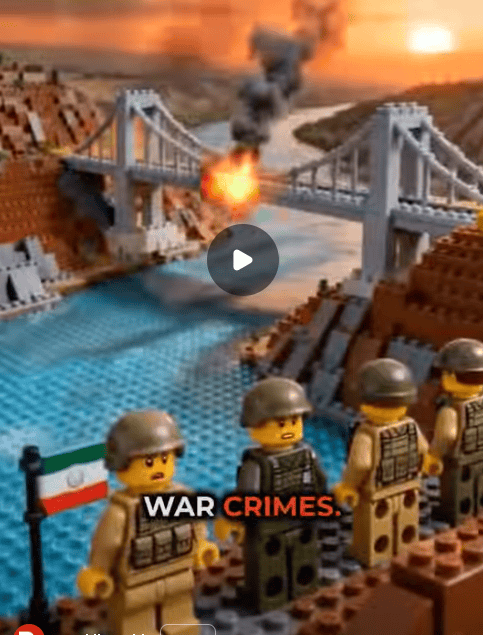
Repetition is how System 1 builds priors. The more often a phrase is encountered, the more fluently it processes, and the more true it feels. Persuasion researchers call this the illusory truth effect. The viewer doesn’t have to consciously agree. Repeated exposure alone shifts the baseline.
Iran is not trying to win a single debate. It’s trying to own a vocabulary.
The Technical Workaround Nobody Is Talking About
There’s another layer here that has nothing to do with cognitive science and everything to do with platform mechanics.
Nobody wants to watch snuff films. Real conflict footage triggers content moderation and gets pulled. Lego cartoons do not, and then they get shared. By wrapping an anti-American narrative in the visual language of a children’s toy, Iran moves its message past the algorithmic gatekeepers and onto feeds of people who never sought it out.
Here’s what’s interesting: I have not seen a single one of these videos appear directly from an Iranian source in my feed. Every one has arrived through reaction videos, someone laughing in a little box in the corner for two minutes while the Iranian propaganda plays in full behind them.
Americans sharing Iranian propaganda, voluntarily, because the engagement is irresistible.
Iran figured out exactly where familiarity and novelty intersect, and built its distribution strategy around that intersection.
Russia has been running the same play. The Lego aesthetic is now a standard instrument of foreign influence operations.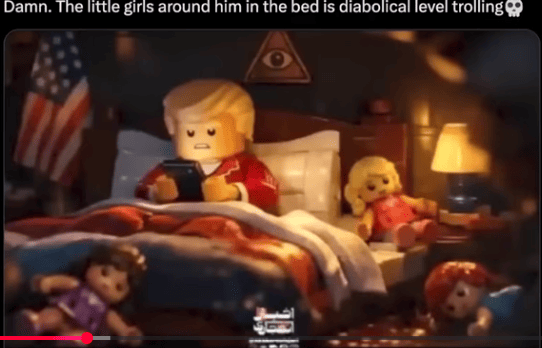
The Audience the United States Is Losing
Iran is not trying to reach its own people with these videos. It’s trying to reach ours.
The President’s meme game is real, but it’s aimed at base cohesion, keeping the already-converted fired up.
Iran is playing a bigger game. It’s producing content calibrated to the persuadable American middle: gas prices, a war with no clear rationale, economic disruption, the Epstein hypocrisy, and the creeping sense that someone is lying about something important.
War has always been fought in the information space. What’s changed is the cost. AI has collapsed the production barrier. Any nation state can now generate animated propaganda at the speed of a news cycle and distribute it globally for nearly nothing.
What Practitioners Need to Understand
If you work in political communications, public affairs, or persuasion of any kind, these videos are not a curiosity. They are a case study.
Dismissing them because of the broken English in the closing title card is the same mistake campaigns make when they write off opposition research as unsophisticated.
Sophistication is not the point. Reach is the point. Repetition is the point. Emotional resonance before analytical processing is the point.
Bypassing the filter through entertainment is the point.
Iran identified the correct behavioral target, System 1. It chose the correct delivery mechanism, entertainment. It applied the correct technical workaround, animation instead of footage.
And it is achieving the correct outcome: a vocabulary distributed at scale that, with enough repetition, will shift what feels true to audiences who never once stopped to think critically about it.
That’s not clumsy propaganda. That’s a behavioral operation.
The question for American communicators isn’t whether this is happening. It’s whether they’re prepared to operate on the same terrain.
P.S. Yes, I am fully aware of the irony. I just wrote a lengthy, egg-headed analysis of why entertainment beats argument, formatted it with section headers, and published it on a website most people will skim. Iran made a Lego rap video. I wrote a think piece. They’re winning this round too.