
 However, occasionally, I find a poll that I find novel and interesting. This is the case!
The think tank Populace released their 2025 report, Populace Insights: Private Opinion in America, and it confirms a suspicion many of us have harbored but could not prove: Americans are lying to pollsters, to their neighbors, and perhaps even to themselves. This isn’t just about “shy Trump voters” or “hidden liberals.” This study reveals a systemic epidemic of self-silencing that distorts our understanding of the economy, social justice, and political violence.
However, occasionally, I find a poll that I find novel and interesting. This is the case!
The think tank Populace released their 2025 report, Populace Insights: Private Opinion in America, and it confirms a suspicion many of us have harbored but could not prove: Americans are lying to pollsters, to their neighbors, and perhaps even to themselves. This isn’t just about “shy Trump voters” or “hidden liberals.” This study reveals a systemic epidemic of self-silencing that distorts our understanding of the economy, social justice, and political violence.Citation & Links
Title: Populace Insights: Private Opinion in America 2025
Link: Populace.org
Peer Review Status: Not Peer Reviewed (Think Tank Report)
Citation: Populace. 2025. “Populace Insights: Private Opinion in America 2025.” Boston: Populace.
Methodology
Most surveys ask direct questions like “Do you support X?” While effective for mundane topics, this approach fails with sensitive subjects. When asked about issues like race, sex, finances, or voting history, people often provide the “socially acceptable” answer rather than their actual beliefs.
In an attempt to explore this, Populace used a List Experiment (also known as the item count technique). They surveyed over 3,000 Americans between March 21 and March 31, 2025. Instead of asking for a direct opinion on a sensitive issue, they showed respondents a list of statements. One group saw innocuous statements; the other saw the same list plus the sensitive statement. By comparing the average number of items selected between the two groups, researchers calculated the percentage of people who agreed with the sensitive item without anyone having to admit it directly. An interesting way to potentially get around the social bias in polling questions.
Results and Findings
The results expose a nation wearing a mask.
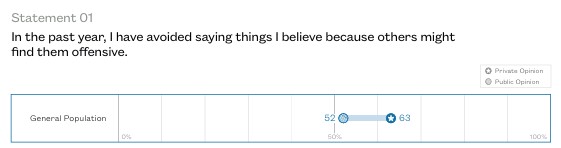
We are a nation of self-silencers: A staggering 63% of Americans admit privately that they have silenced themselves in the past year because they feared others would find their views offensive. Publicly, only 52% admit this. The highest rates of self-silencing are among those earning over $150k (82%) and Democrats (77%).
The economy is worse than we say: Publicly, 29% of people say the economy is doing well. Privately? Only 16% believe it. This pessimism has deepened significantly since 2024.
Political violence is becoming a private option: While public support for political violence remains low, private support has tripled since 2024, jumping from 4% to 12%.
DEI is safer than critics think: Public support for dismantling Diversity, Equity, and Inclusion (DEI) initiatives stands at 35%. However, private support for dismantling these programs dropped to 29% this year. Americans are actually less hostile to DEI in private than they act in public.
The “Fair Society” Myth: 35% of Americans will tell you publicly that society is mostly fair. In private, only 11% actually believe it.
Deeper Dive
Imagine you are at a dinner party. Someone asks if you think the country needs a violent revolution. You would likely say “no” immediately to avoid looking like a radical. That is Social Desirability Bias. Standard polls suffer from this bias constantly.
The list experiment is like a magic trick that removes the pressure to look good. The researchers do not ask you to raise your hand for the sensitive topic. They just ask, “How many of these 4 things are true for you?”
- I own a dog.
- I like pizza.
- I own a car.
- I support political violence.
If the average count for the group without the violence question is 2.0, and the average for the group with the violence question is 2.12, the researchers know that 12% of the group privately supports violence. They know this without a single person ever explicitly saying “I support violence.”
This method reveals that the “silent majority” is not just one political side. It is everyone. High-income Democrats are terrified to speak their minds. Republicans pretend the economy is great publicly (44%) but admit it is terrible privately (26%). We are all performing a role.
“Whoever would overthrow the liberty of a nation must begin by subduing the freeness of speech.” — Benjamin Franklin
Why It Matters
We build public policy, corporate strategies, and political campaigns based on what people say. If what they say is a lie, our foundations are rotten.
The sharp rise in private support for political violence (especially among Independents, where it jumped from 2% to 15%) is a flashing red light for national stability. If leaders rely on public polling that shows low support for violence, they will be blindsided by actual unrest. Similarly, companies rolling back DEI initiatives based on perceived “public backlash” might be over-correcting, as private hostility to DEI is actually shrinking.
Critiques and Areas for Future Study
While the sample size of 3,000 is robust, the study relies on a snapshot in time (March 2025). The report notes that the survey occurred just days before the Trump administration announced sweeping tariffs. This timing could skew economic pessimism data.
Critically, while the list experiment detects what people believe, it does not explain why the gap exists. Why do high-income earners feel the most pressure to silence themselves? Is it fear of losing their jobs or fear of social ostracization? Future studies should combine this method with qualitative interviews to understand the specific fears driving this masquerade.
Practical Implications for Policy Makers
- Trust is a Ghost Town: Only 4% of Americans privately trust the government to tell the truth. Any policy announcement must assume a baseline of zero credibility. You cannot message your way out of this; you must demonstrate results.
- Independents are Volatile: The group most rapidly radicalizing toward violence is not the fringe right or left; it is Independents. Ignoring this group’s private frustration invites instability.
- The “Fairness” Gap: With only 11% of people privately believing society is fair, policies that assume a level playing field will be met with cynicism. Frame policies around “creating equal opportunity,” which 74% of Americans still support.
Practical Implications for Public Affairs Officials
- Discount the Noise: When you see a wave of public outrage (or support) for a cultural issue like DEI, assume it is exaggerated. The private data suggests people are far more moderate than their public statements imply.
- Create Private Channels: Your employees and stakeholders are self-silencing. If you rely on town halls or public surveys for feedback, you are getting bad data. Use anonymous channels to find the truth before it explodes.
- Economic Reality Check: Do not gaslight your audience with “strong economy” talking points. The private data shows deep, bipartisan pessimism. Acknowledge the pain to build credibility.
Final Thoughts
For me, this research is a breath of fresh air. It ignores the superficial “horse race” of daily tracking polls to reveal the track itself.
It exposes the widening gap between our public faces and our private beliefs. For anyone in the business of understanding people, this report is a crucial reminder that the “socially acceptable” answer is rarely the honest one.
We don’t need better voters; we need better ears. The most valuable data in modern politics isn’t what is being shouted by the loud minority, but what is being withheld by the silent majority.
Maybe, it is time we stop listening to the noise and start measuring the silence.