
43.8%
That is the percentage of Republicans in our recent survey who exhibited a “gap” on the topic of childhood vaccines. Publicly, they perceive a specific party line. Privately? They believe something entirely different.
Following our previous post on the 2025 most interesting poll, I ran an experiment during the holiday break to measure this “Quiet Gap”: How much do we self-censor for our political tribes?
The results were fascinating, occasionally contradictory, and human.
Methodology (The “Grain of Salt” Section)
Let’s get the housekeeping out of the way first. This wasn’t a massive Pew Research study; it was an exploratory I-am-bored-over-the-holidays pulse check.
We collected data between December 19, 2025, and January 11, 2026, from 153 respondents via social media (X, Facebook, LinkedIn) and Reddit.
The Caveats:
- The “Non-Unfriended” Bias: The Republicans in this sample are largely people who have chosen not to unfriend me. They likely represent a specific, perhaps more moderate or digitally savvy, slice of the electorate.
- Sample Size: With 153 people, these numbers are anecdotal. Treat this as a flashlight in a dark room, not a GPS map of the entire country.
Survey Logic and Design
The survey utilized branching logic to test specific partisan pressures across twelve core questions:
- Republicans and Republican leaners: Responses were collected on four topics: President Trump’s command of faculties, White House decision-making, the transparency of the President’s recent MRI, and economic price caps .
- Democrats and Democrat leaners: Respondents were asked about four topics: socialist policies, gender in sports, DEI training effectiveness, and temporary border closures .
- Universal Questions: All respondents were asked about four shared issues: the Venezuelan oil blockade, ICE raids, import tariffs, and childhood vaccine requirements .
For each topic, respondents provided two distinct answers: how most people in their party would answer publicly, and how they personally feel in their “heart of hearts”
Participant Profile
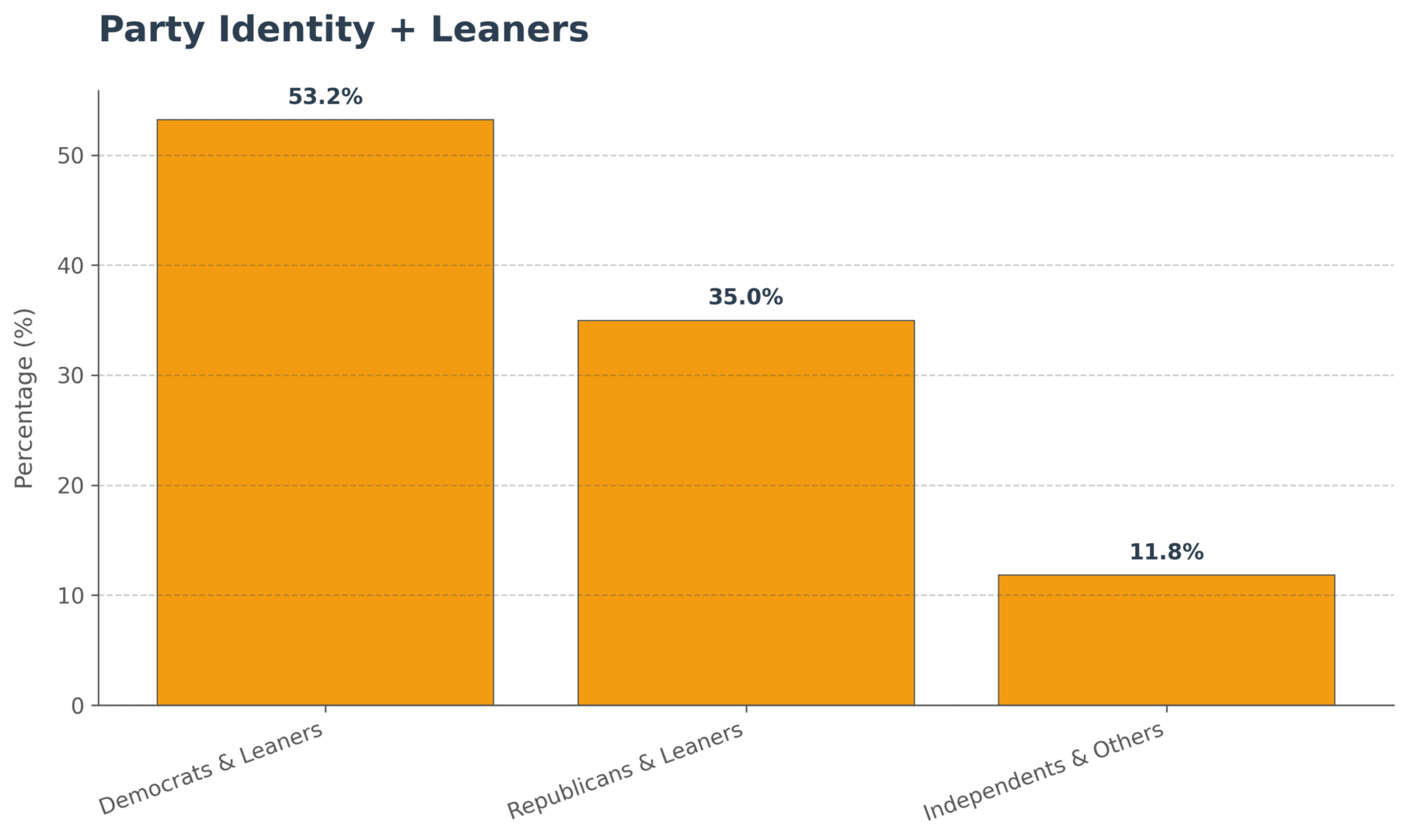
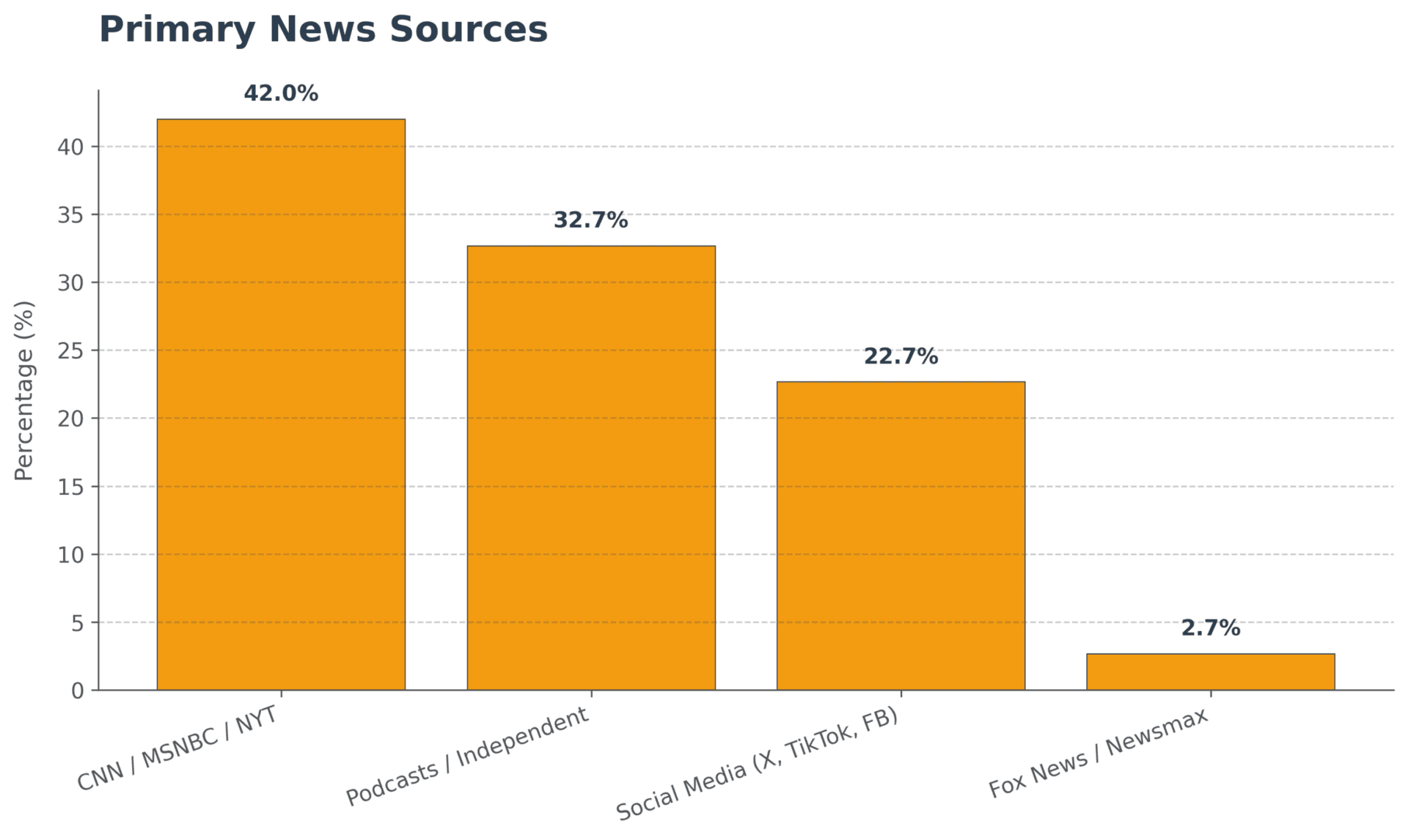
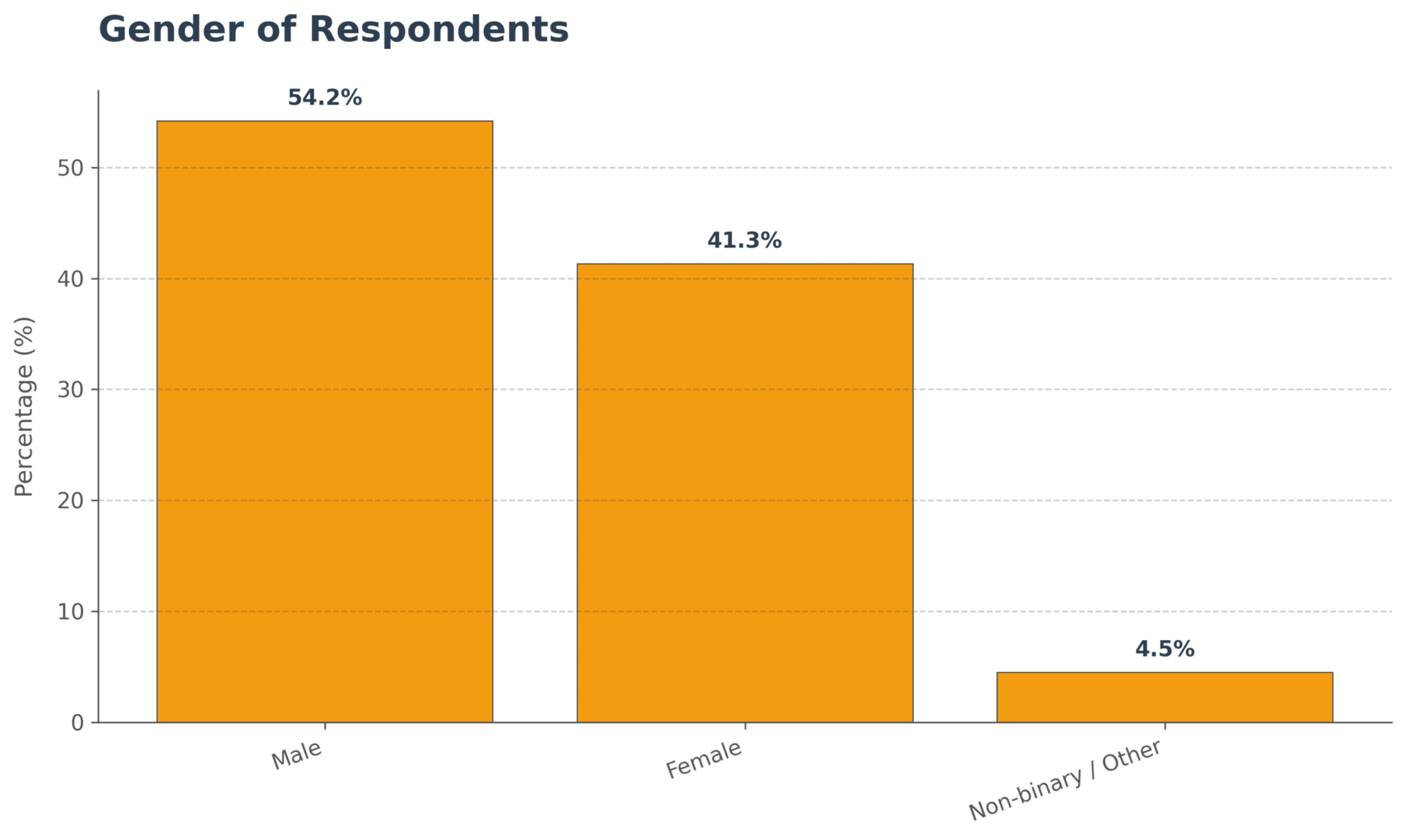
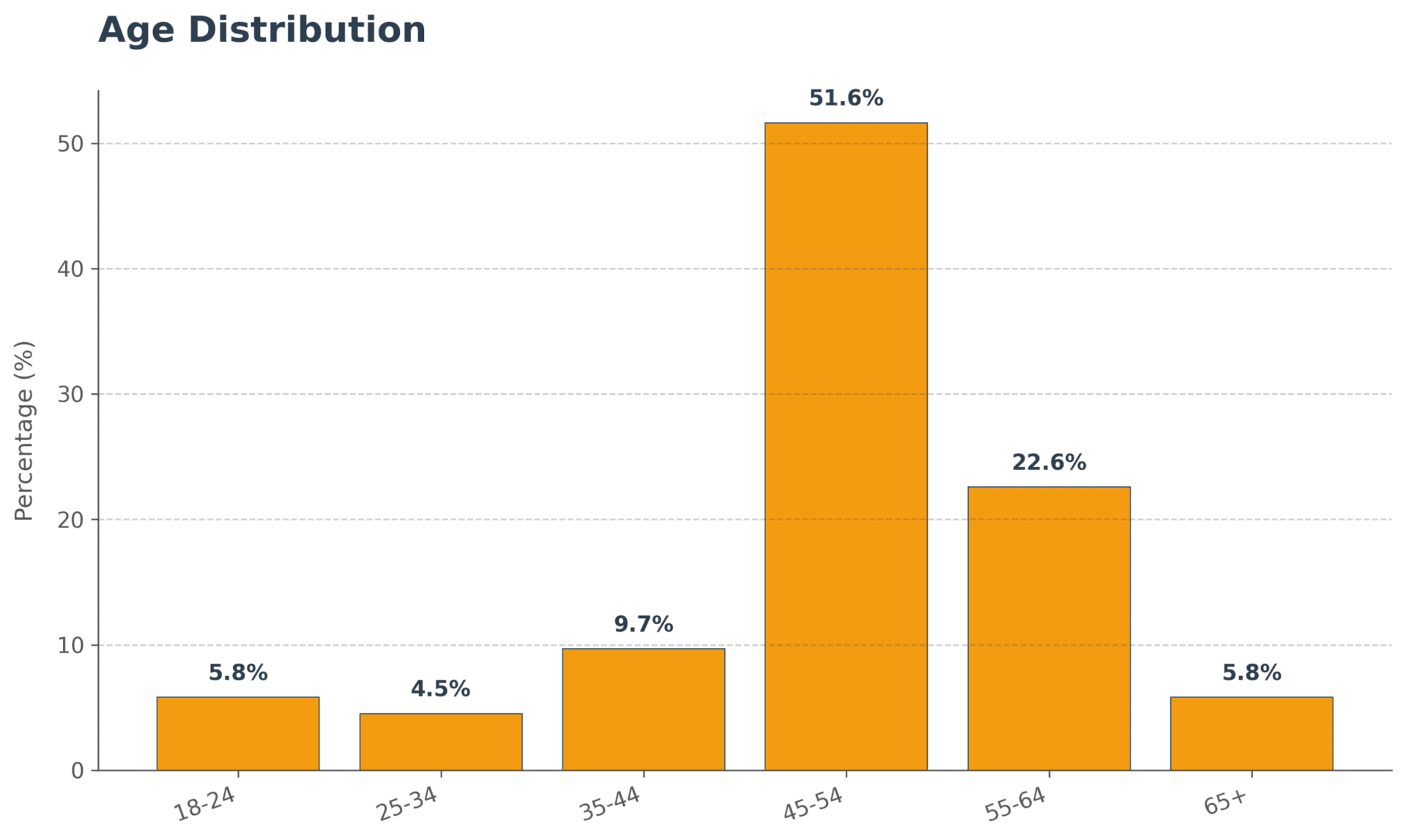
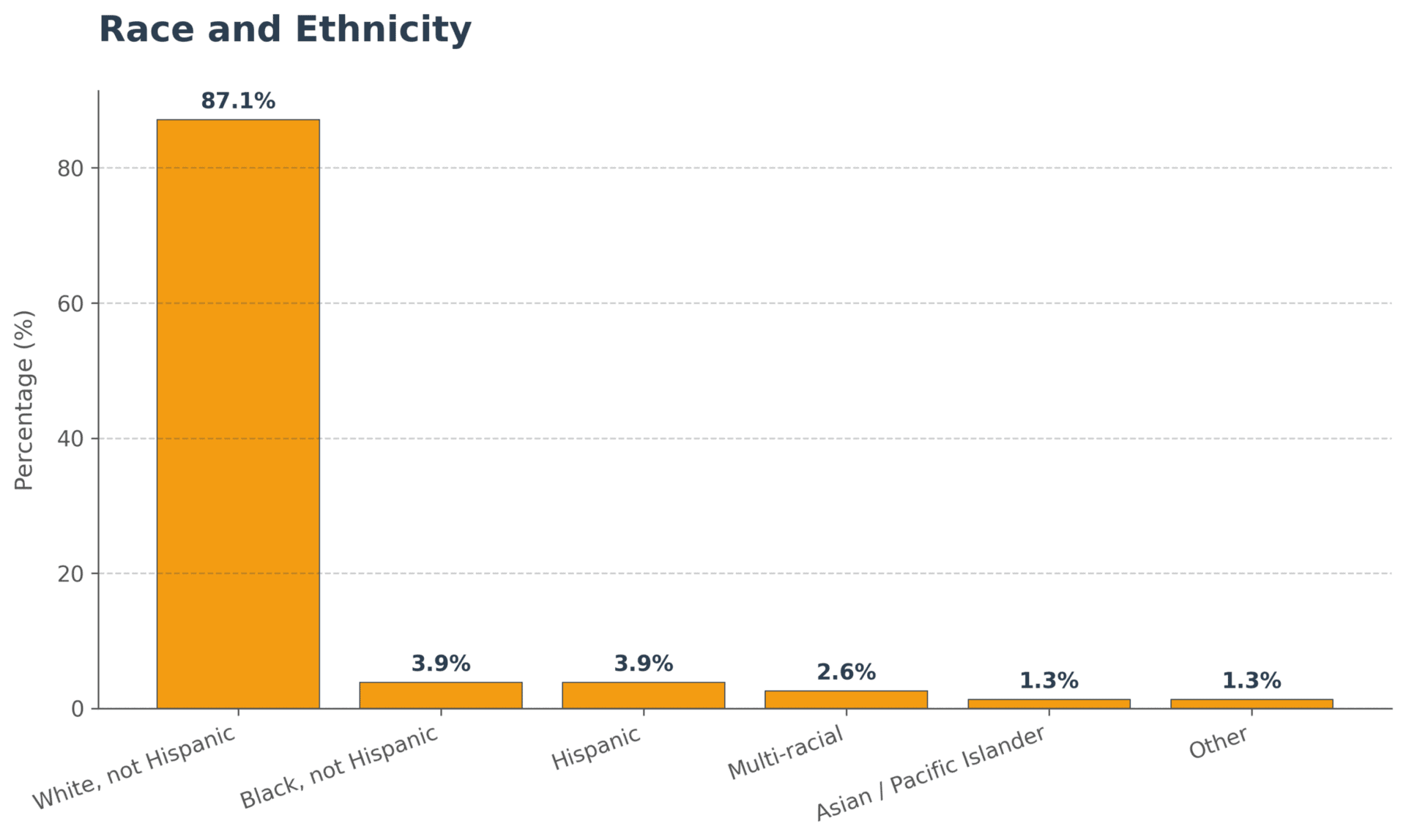
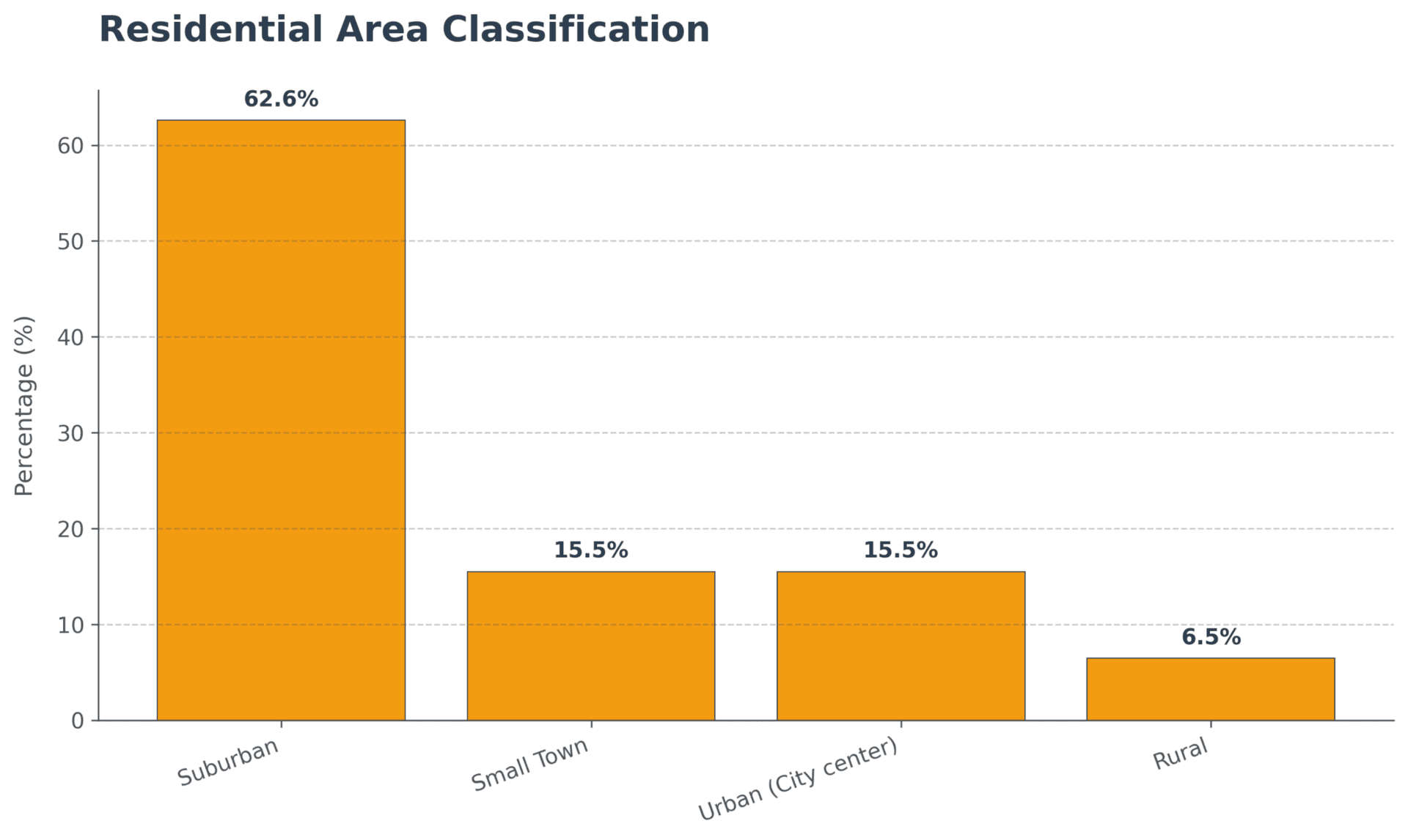
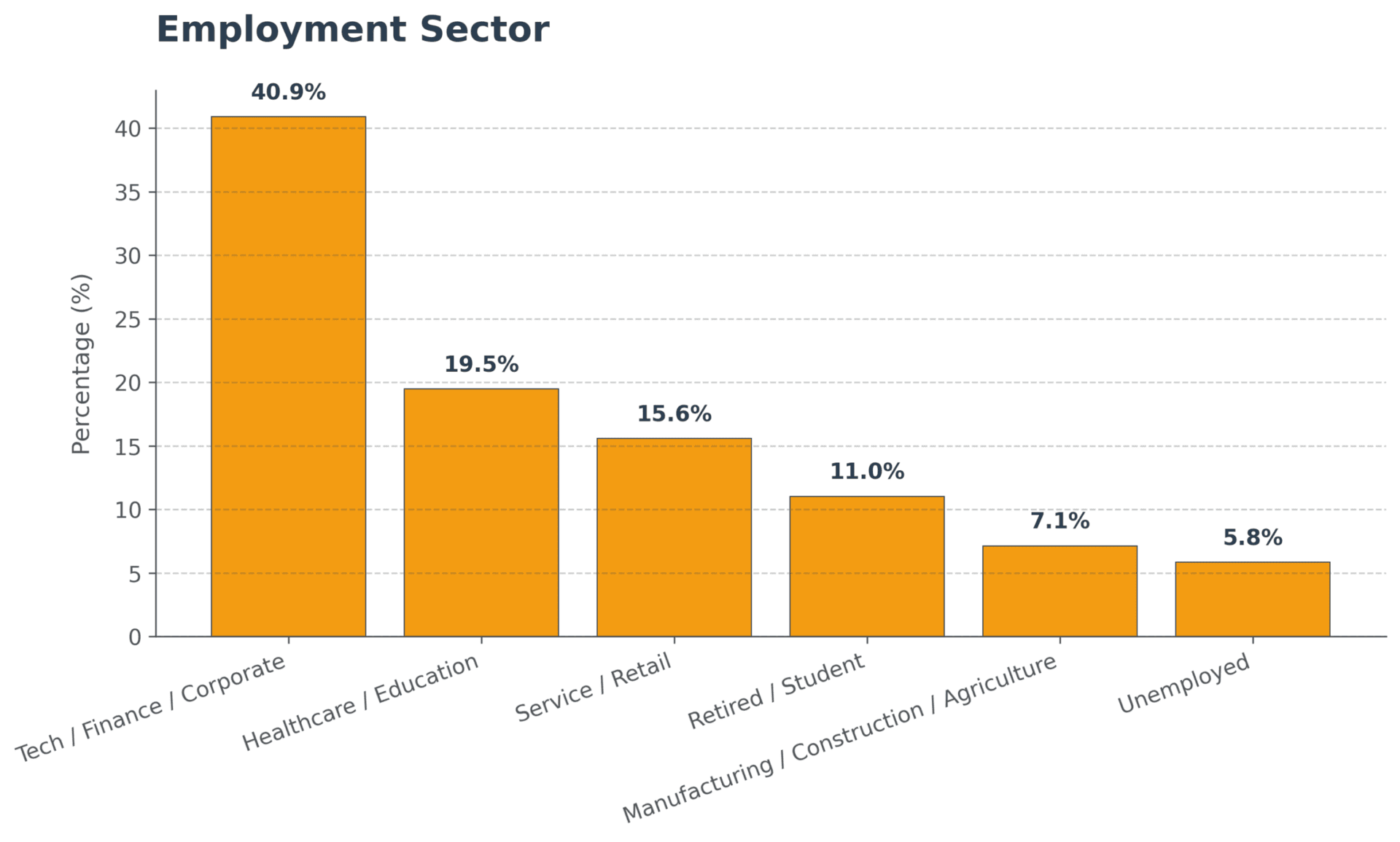
Before diving into the opinion gaps, we mapped the demographics of our participants. Our sample skewed toward social media-active users, with a diverse mix of employment sectors and news consumption habits.
Finding Republicans: The Identity Gap
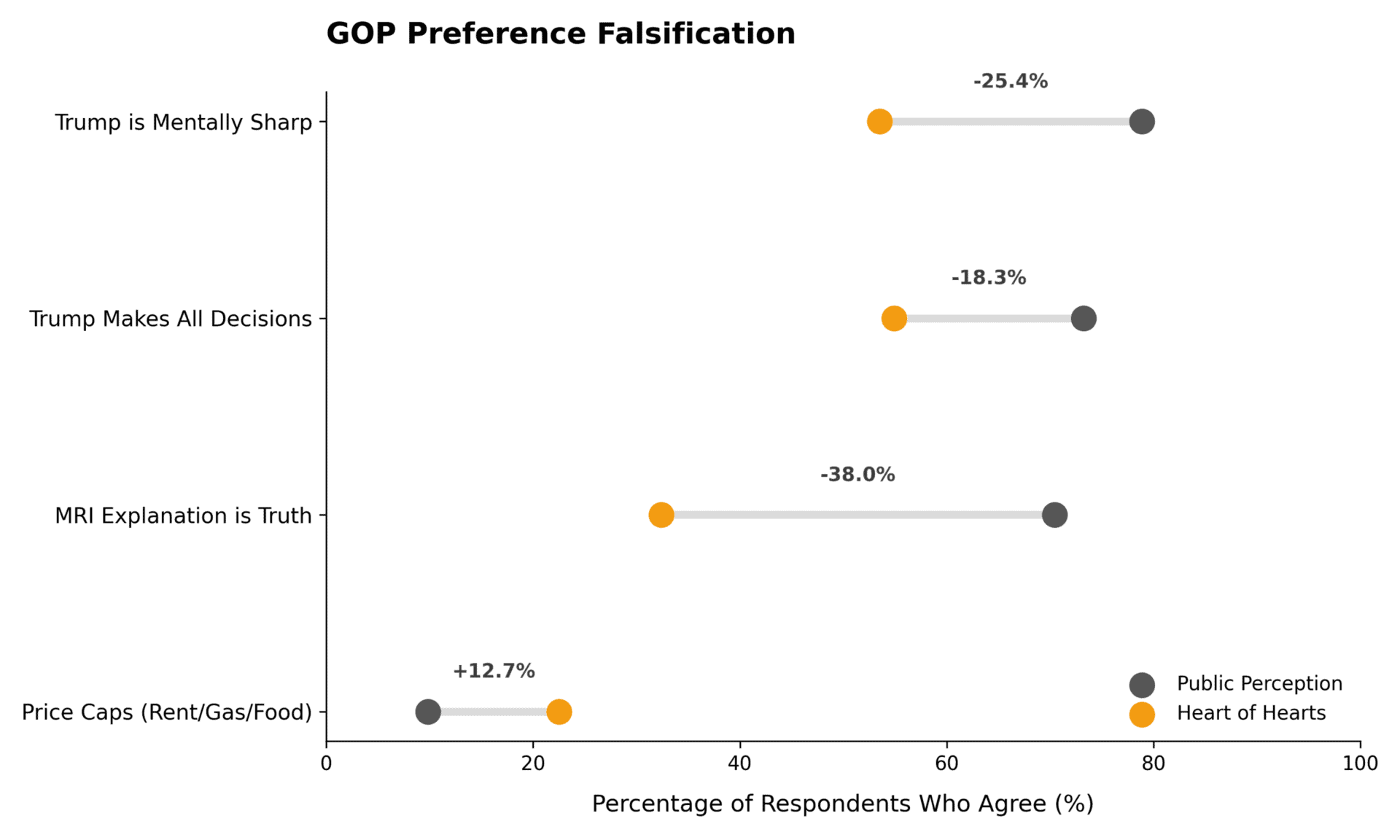
We presented Republicans and Republican leaners with four statements on leadership and economic policy. For each, they told us two things: what most people in their party would say publicly, and what they personally believe.
The chart shows their answers. Slate Gray dots mark the perceived public expectation (the “Mask”). Orange Gold dots mark their private belief (the “Truth”). The line between them measures self-censorship. The gaps are largest on leadership transparency and populist economic interventions.
Finding Democrats: The Cultural Strain
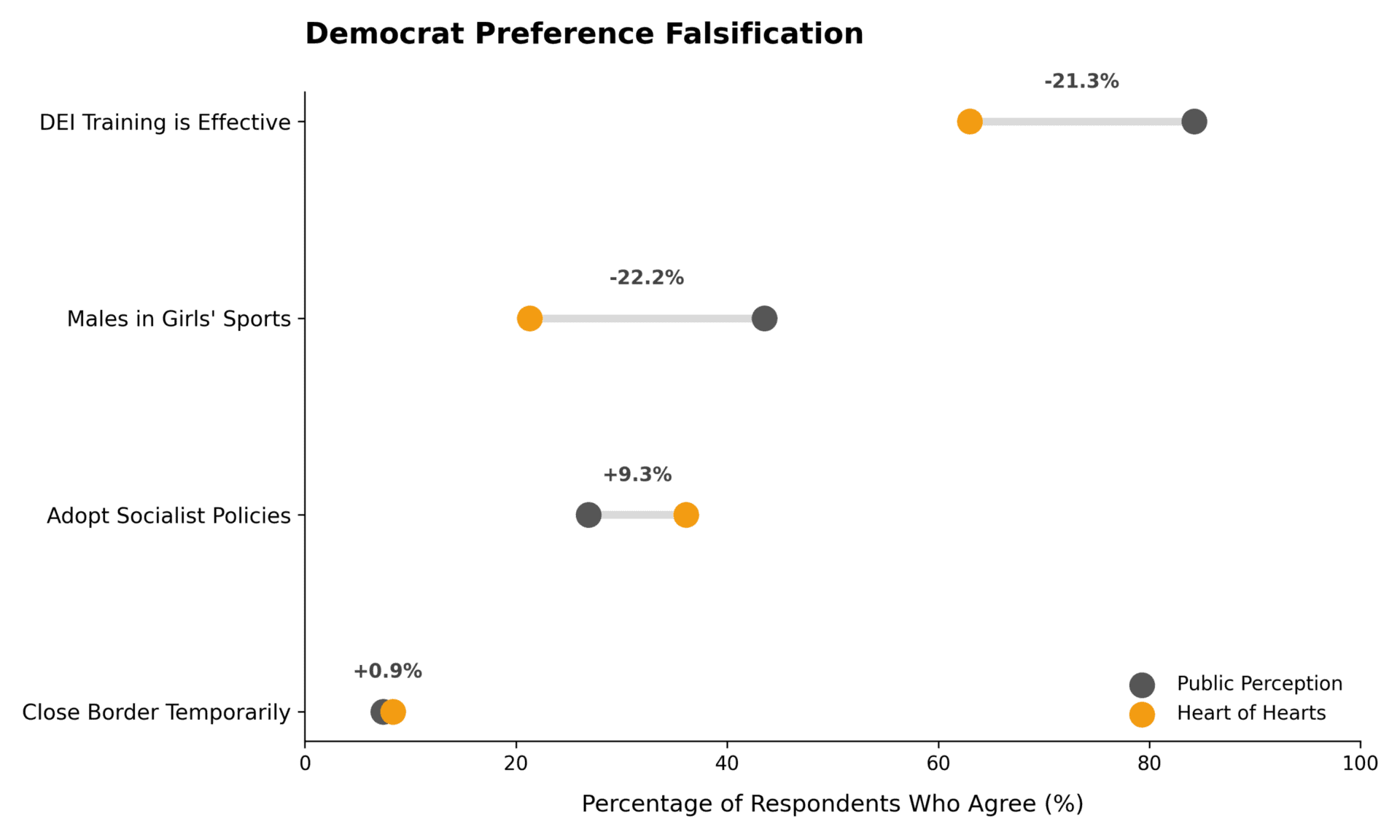
We asked Democrats and Democratic leaners about four ideological and cultural litmus tests using the same two-answer format.
The gaps are widest on cultural topics where the party platform appears most rigid. Nearly 40% of Democrats privately diverge from what they perceive as their party’s public stance on socialism and gender in sports.
Finding ALL & Cross-Tabs: Universal Issues
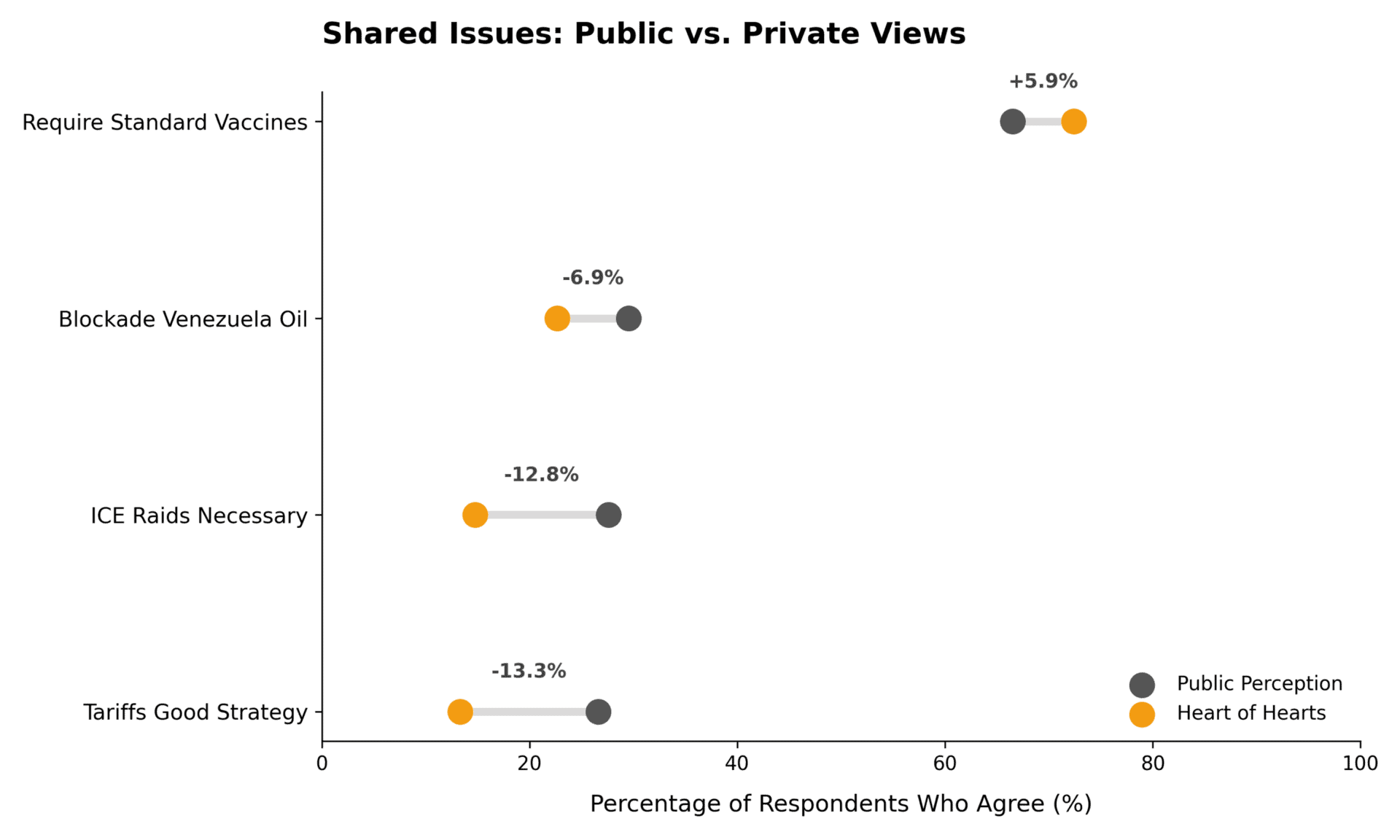
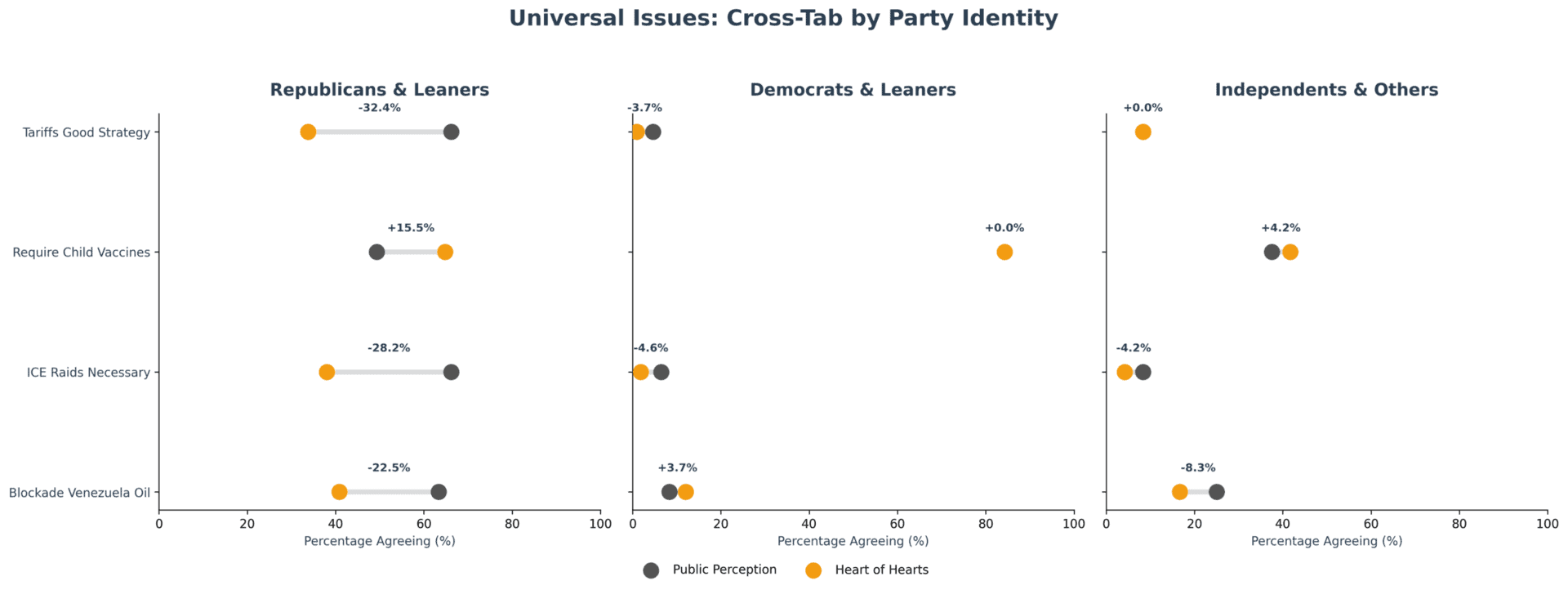
We asked all respondents about four shared national issues: the Venezuelan oil blockade, ICE raids, import tariffs, and childhood vaccine requirements.
Cross-tabulating by party reveals something striking: the Honesty Gap on shared issues splits unevenly. Republicans show a 43.8% gap on vaccines. Democrats show 9.3%. On ICE raids, Republicans gap at 34.2% while Democrats gap at 5.5%.
The pressure to conform hits harder on one side, even when the issues transcend party lines.
The Independent Baseline
A notable finding in the preliminary data was the behavior of Independent respondents. Because they lack a formal party identity to maintain, the gap between their perceived “public” answer and their “private” feeling was significantly smaller than that of partisans . This indicates that the pressure of party identity is a primary driver of the self-censorship observed in the other cohorts.
Discussion: The Dynamics of Partisan Pressure
The ‘Public Mask’ weighs heavily on both parties, but differently.
Republicans feel intense pressure regarding loyalty and medical skepticism (MRI Transparency and Vaccines).
Democrats feel the squeeze on cultural orthodoxy (Socialism and Gender issues).
In both cases, significant portions of these teams nod along while disagreeing internally.
The data suggests that Republicans in this sample are self-censoring at a higher rate. Specifically, they show a 30.3% gap compared to 20.4% for Democrats. We must view this finding through the lens of our sample’s inherent uncertainty.
In this context, the gap might not represent the Republican party as a whole.
The Largest Gaps
| Variable Category | Question | Republican Gap | Democrat Gap |
| GOP Specific | MRI Transparency | 41.1% | — |
| Dem Specific | Socialism | — | 40.4% |
| Dem Specific | Transgender Sports | — | 38.5% |
| Universal | Standard Vaccines | 43.8% | 9.3% |
| Universal | ICE Raids | 34.2% | 5.5% |
Key Takeaways
- The ‘Team Pressure’ is Bidirectional: Both parties have sacred cows. Democrats gap widest on Socialism (40.4%) and Transgender Sports (38.5%). Republicans gap widest on MRI Transparency (41.1%) and Childhood Vaccines (43.8%).
- Republicans Feel More Universal Pressure: The Republican gap remains high even on shared national issues. On Childhood Vaccines, Republicans show a 43.8% gap while Democrats show 9.3%. On ICE Raids: Republicans 34.2%, Democrats 5.5%.
- The Single Largest Gap: Childhood Vaccines at 43.8% among Republicans.
Conclusion
This exploratory project was not designed to find a single truth for the entire American electorate. Its purpose was to see if we could identify the mechanism of self-censorship worthy of additional study. We likely did.
The discrepancies found in universal issues like vaccines and trade suggest that our political discourse is often a performance. We are arguing with “Masks,” not people.
And that leads to a difficult realization about our current discourse:
If up to 40% of the public consensus is just a performance, we aren’t looking at the true will of the people. We’re looking at a mirage.
How can we find truth when people fear speaking it?
If we want to understand where the country stands, we must stop demanding conformity.
We need places (I strongly suggest pubs) where people can discuss their ideas without fear of attack or ostracism.