
Why do projects with wide regional support die in local zoning hearings? Because most engagement strategies ignore the psychological impact of distance.
Every experienced real estate developer knows the pattern. You have a project that makes perfect sense on paper. The economic impact study is stellar. Citywide polling shows 65% support for “new development” and “housing solutions.” You have the capital, the land, and the architectural drawings.
Yet, you walk into the crucial town hall meeting, and you are ambushed. The room is packed with angry faces, and your 65% support is nowhere to be found. Your approval is voted down, or indefinitely delayed in committee hell.
What went wrong?
The answer isn’t that the community is “irrational.” The answer is that your engagement strategy likely ignored the most powerful variable in real estate politics: Proximity.
If you treat a homeowner across the street the same way you treat a voter across town, your strategy is predictably doomed to fail. Here is the academic research behind why proximity weaponizes opposition, and how developers must adapt their public affairs strategy to survive it.
The Science of “Nearness”: Construal Level Theory
Why does the same person support “Clean Energy” conceptually but fiercely oppose a solar farm a mile down the road?
Academics call this Construal Level Theory (CLT). Pioneered by psychologists Yaacov Trope and Nira Liberman, CLT posits that humans process objects differently depending on their “psychological distance.”
- Distant Objects (Abstract): When something is far away (spatially or temporally), we focus on high-level desirability. (e.g., “We need more housing to fix the local economy.”)
- Near Objects (Concrete): As an object moves closer, our processing shifts to low-level feasibility and concrete details. (e.g., “Where will the construction trucks park at 7 AM? Will that roofline cast a shadow on my tomato garden?”)
The Industry Blind Spot: Most developers use “Abstract” messaging (jobs, tax revenue, growth) on “Concrete” audiences (abutters). This cognitive disconnect feels dismissive to neighbors, fueling NIMBYism. You cannot address concrete anxieties with abstract platitudes.
Updating the Model: The “Proximity” Variable
For decades, the gold standard for prioritizing stakeholders was the Stakeholder Salience Framework (Mitchell, Agle, & Wood, 1997). It categorized people based on three attributes: Power, Legitimacy, and Urgency.
However, modern research in construction management has forced an update to that model. Recent studies, such as those led by Derakhshan (2022), have identified a vital fourth attribute: Proximity.
Proximity acts as a force multiplier for Urgency. A stakeholder with low power and moderate legitimacy suddenly becomes highly salient if they share a property line with your site.
Why? Because proximity turns a theoretical preference into a fight for territory.
The Ozean Solution: Spatial Resource Allocation
At Ozean, we apply these academic insights to build what we call a Spatial Stakeholder Strategy. We move beyond generic “community engagement” and use the research of Samantha Miles (2017) to distinguish between two critical groups:
- Claimants (High Proximity): These are your abutters and immediate neighbors. They have a moral “claim” on the outcome because they live with the consequences. They require negotiation on concrete details (noise, traffic, views).
- Influencers (Low Proximity): These are city-wide activists, local bloggers, or distant NGOs. They have a voice, but no spatial stake. They require media containment strategies, not negotiation.
If you spend your time (and budget) trying to “negotiate” with a distant Influencer while ignoring a proximate Claimant, you will lose the zoning vote. The Influencer usually wants a story; the Claimant wants to protect their backyard.
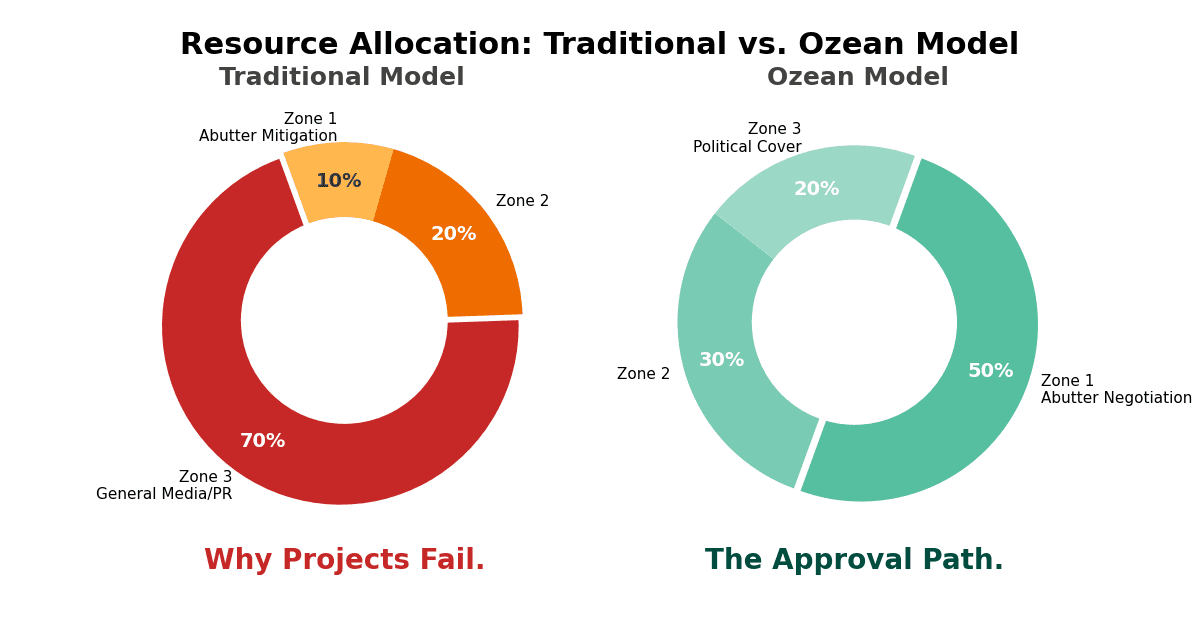
Applying the “Salience Zones” Strategy
To win difficult approvals, you must segment your messaging (and your budget) spatially.
1. Zone 1 (The Abutters): Address the Concrete
- The Strategy: Negotiation & Mitigation.
- The Tactic: Stop selling them on “Regional Growth.” Sit in their living rooms and discuss the construction mitigation plan. Show them the shadow studies. When you address their concrete fears with concrete solutions, you lower their “Urgency” score, preventing them from becoming “Dangerous” stakeholders.
2. Zone 2 (The Neighborhood): The Hybrid Approach
- The Strategy: Transactional Engagement.
- The Tactic: These stakeholders are close enough to worry about traffic, but far enough to appreciate value. Here, you trade concrete mitigation (new sidewalks, traffic calming) for abstract benefits (rising property values). This is the “swing vote” of your project.
3. Zone 3 (The Region): Activate the Abstract
- The Strategy: Political Cover.
- The Tactic: This is where you deploy your economic impact data. You engage this zone not to convince the neighbors, but to provide cover for the City Council. The Council needs to know that while the 50 people in the room are angry (Zone 1), the 50,000 people outside the room (Zone 3) support the project’s goals.
Conclusion: Updating the Playbook
NIMBY opposition is rarely a random emotional outburst. It is a predictable psychological reaction to spatial proximity.
If your public affairs strategy relies on the same press release for the person next door and the person next town over, you are operating on an obsolete playbook. To win approvals in today’s polarized environment, you need to measure the distance, calculate the salience, and allocate your resources where the physics of influence actually apply.